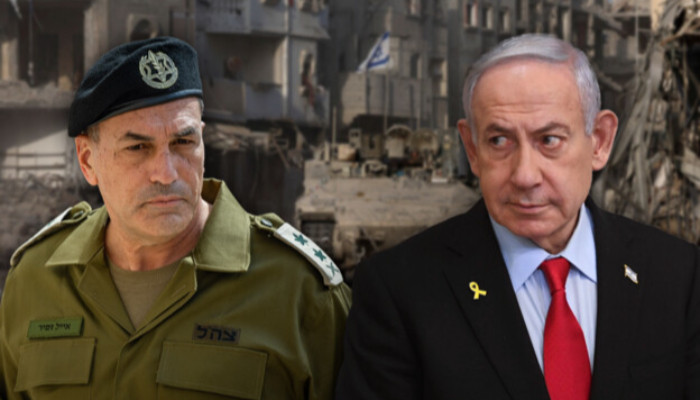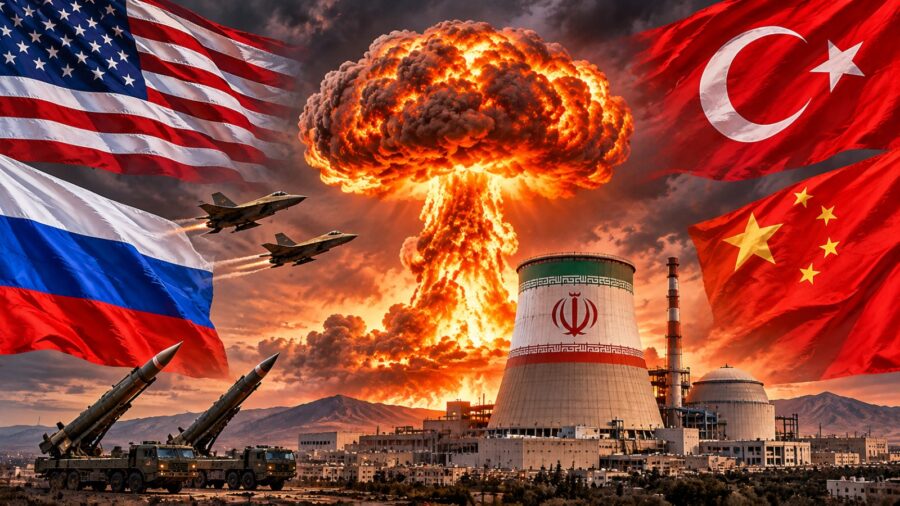
Claims that the United States will launch a nuclear strike on Iran have caused serious concern in recent days. President Donald Trump’s unpredictable political decisions, Washington’s tough stance towards Tehran and Israel’s maximalist demands regarding Iran have made this scenario more serious.
In general, the possibility that the United States could increase military pressure on Iran in the coming days, or even launch new and larger-scale strikes, is quite serious. However, there is no basis for saying this will necessarily result in a nuclear attack. The use of nuclear weapons is not merely the next stage of a military operation, but a strategic decision that could change the rules of the international security system as it has developed to date.
The nuclear claim
One of the main reasons for these discussions is claims made on November 1 by Tucker Carlson, a former Fox News host in the United States. He said the Trump administration could launch a nuclear strike on Iran in the coming days. According to Carlson, Israeli Prime Minister Benjamin Netanyahu is pressuring the US president to strike facilities linked to Iran’s nuclear programme. He also claimed that there are differing approaches to the issue within the US administration.
Carlson’s statements are not an official decision or a confirmed military plan. This must be understood above all else. I repeat, the existence of a military confrontation between the United States and Iran does not mean that the threat is entirely baseless. The United States wants to strike Iran’s nuclear facilities, but this does not automatically mean the use of nuclear weapons. Washington has conventional bombs and other military means with high destructive power, but without nuclear warheads, to target underground and fortified facilities. In other words, even if the United States seeks to disable Iran’s nuclear infrastructure, it can do so without resorting to nuclear weapons.
Moreover, in an interview with Reuters on October 16, Trump said he was not considering using nuclear weapons against Iran and that there was no need for such a weapon. This statement also requires the claims of a nuclear strike to be treated with caution.
Could Trump really use nuclear weapons?
It is no secret that Trump likes to act differently from traditional diplomatic approaches, pressure his opponents with tough statements and demonstrate military power. Unpredictability holds a special place in his political style. From this perspective, the possibility that Trump could make a serious military decision against Iran can never be ruled out. However, the issue of using nuclear weapons is on an entirely different plane. The US president has the authority to make such a decision, but its consequences would not be limited to a decision made at the White House. The consequences of a nuclear attack would affect the United States’ international standing, its relations with allies, its economy and the global security architecture.
For example, Washington’s main goals regarding Iran are to prevent Tehran from acquiring nuclear weapons, limit its missile capabilities and weaken Iran’s influence in the region. Using nuclear weapons to achieve these goals would run directly counter to the security principles established by the United States itself. In other words, the use of nuclear weapons by the United States, which seeks to prevent Iran from acquiring them, would create a serious political and logical problem before the international community.
Worst of all, this step could send other states the message that countries without nuclear weapons are more vulnerable to military pressure from major powers. As a result, a number of states would become more interested in acquiring nuclear weapons to ensure their security. Saudi Arabia, Egypt, the UAE and Turkey already want to acquire these weapons. But after such an event, no one would be able to stop the countries I have named.
What consequences could Iran’s response have?
Clearly, if the United States launches a nuclear strike on Iran, Tehran will not remain silent. By way of comparison, this is not about the atomic bombs dropped on Nagasaki and Hiroshima. The Japanese were seeing this weapon and the destruction it caused for the first time, and they surrendered. Iran, while not officially possessing this weapon, knows its existence and potential well.
Although Iran’s response capabilities may appear limited in a direct comparison of military strength with the United States, its ability to exert influence in the region is quite extensive. For example, Iran could use all its strength to strike Israel with missiles and drones, target US military bases in Persian Gulf countries, and expand the geographical scope of the confrontation through allied armed groups in the region. In addition, the issue of the Strait of Hormuz is of particular importance. Restricting shipping on this strategic route, through which a significant part of global oil trade passes, could deal a serious blow to the global energy market. A sharp rise in oil prices, higher transport costs and problems in energy supplies would affect not only Middle Eastern countries but also the economies of Europe and Asia.
Could Russia and China join this war?
One of the most dangerous aspects of the possibility of a nuclear strike is the likelihood that major powers could become involved. Russia and China are not interested in Iran being completely eliminated by the United States. Both countries have political, economic and geopolitical interests in the region.
Iran is particularly one of Russia’s important partners in the Middle East. Tehran’s weakening would also negatively affect Moscow’s ability to exert influence in the region. China, meanwhile, does not want the war to expand in view of its energy security, trade routes and economic interests in the Middle East.
Under normal conditions, Moscow and Beijing would not start a direct war against the United States. But if nuclear weapons were used against Iran, Beijing and Moscow could interpret this as an attack that could be carried out against them tomorrow and join the war. The possibility of a Third World War could arise precisely in this case. If the confrontation does not remain limited to Iran and the United States but expands through direct military intervention by Russia, China and other major powers, then we would no longer be talking about a regional war, but a global security crisis.
What risks does Azerbaijan face in this process?
Azerbaijan has opposed intervention in Iran from the outset and supports the principle of states’ territorial integrity. At the same time, Baku takes into account its direct border with Iran, as well as energy and transport projects in the region and its geopolitical interests in the Caspian basin. The expansion of the war would, of course, affect Azerbaijan.
First of all, a breakdown of stability within Iran and a possible humanitarian crisis would mean Azerbaijanis and other ethnic groups in that country moving towards the border and heading to Azerbaijan.
Moreover, an expansion of US and Israeli military operations could lead Tehran to take a tougher approach towards states in the region. We have witnessed Tehran losing control in such situations in the recent past.
Although rising oil prices could bring certain economic advantages, instability in global trade, logistics and financial markets would create risks for Azerbaijan’s economy.
I believe that at the current stage, the possibility of the United States launching large-scale military operations against Iran with conventional weapons is more realistic than it launching a nuclear strike. It is theoretically possible for Trump to decide to use nuclear weapons, but the political, military and geopolitical consequences this would create for the United States make such a step impossible.
Trump’s main aim is not so much to completely destroy Iran through war as to force it to accept Washington’s terms at the negotiating table. Military pressure, sanctions and displays of force are more manageable tools at his disposal for this purpose. A nuclear strike, by contrast, would spread the conflict across a wider geographical area and cause it to spiral out of control.

Turan Rzayev
Political writer at Globalinfo.az
Read also