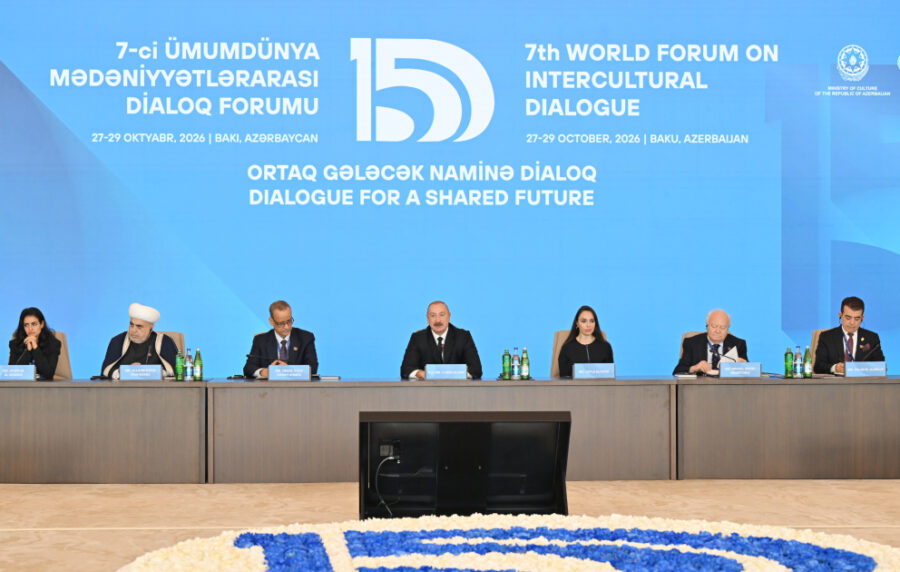
President Ilham Aliyev’s remarks at the opening of the 7th World Forum on Intercultural Dialogue are noteworthy in many respects. However, one point made by the head of state, I believe, once again brings into focus the risks we have faced in recent years.
The president said that Azerbaijan has no internal risks and that all potential risks come from beyond its borders.
The head of state said: “Ideological risks are as dangerous as physical risks. Therefore, we must always be vigilant and remain deeply committed to preserving our identity, statehood, independence and way of life.”
Indeed, Azerbaijan currently faces potential ideological risks from several foreign countries.
First, one of the main ideological threats to Azerbaijan has always come from the south. The religious-radical ideology that Iran exports to neighbouring countries and regions as part of the “Shia crescent” has often created serious threats and risks for our country. In fact, many examples could be cited. However, I believe it is noteworthy that attempts have been made to portray the organisation of citizens protesting against rules introduced on a unified school uniform, their concerns and sensitivities, as events stemming from a religious ideology exported from Iran. Even the peaceful protests of some parents were accompanied by incidents such as attacks on schools, radical slogans and attempts at mass disobedience.
There is no doubt that this is not a domestic social demand but a manifestation of instructions from abroad — Tehran’s approach. This is confirmed by Iranian Minister of Science, Research and Technology Hossein Simayi Sarraf’s opposition to the introduction of a unified school uniform in Azerbaijan and his statement that he could create a “free educational environment” for girls who claim they have been deprived of their right to education, saying: “Iranian universities are ready to admit Azerbaijani girls.”

The worst aspect is that, although operations have been carried out in the country for years against Iran’s influence groups, operatives and ideological strongholds, and preventive measures have been taken, it is possible to see these cell-based organisations re-emerge from time to time.
Second, another external ideological influence on our country comes from our northern neighbour, Russia. In particular, radical Salafi-Wahhabi and, to a certain extent, Lezgin separatist ideology is exported from Dagestan in Russia’s North Caucasus region. In general, the threats that are being created through organisations such as “Sadval” and the “Forest Brothers”, as well as the ideological poison that is being exported, have reappeared in recent years. However, the consistent operations of the State Security Service neutralise these threats before they can grow.
Third, and, in my view, the most regrettable are the ideological provocations carried out against our country through Turkey in recent times. The Nursi-Gulenist ideology and political Islamists viewed by the ruling Justice and Development Party (AKP) as the current followers of this ideology are carrying out sustained provocations against our country.
Given that such ideological risks can be exported from an allied and friendly country, the head of state’s words that “all potential risks come from beyond our borders” take on special significance.
Turan Rzayev
Political writer at Globalinfo.az
Read also