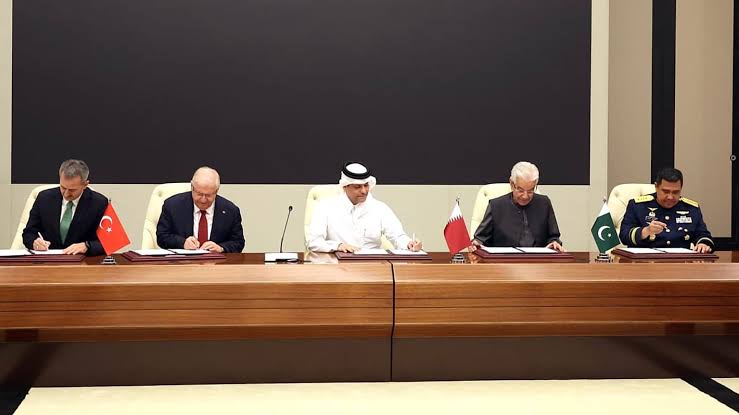
“On Wednesday, Turkey, Qatar, Pakistan and Indonesia signed the ‘Badr’ defense industry memorandum, covering joint production, research and development, as well as military training. The document was signed by the defense ministers of Qatar, Pakistan and Turkey, while Indonesia was represented at the meeting by a deputy defense minister. The document does not contain a mutual defense clause. That is exactly the hint.”
Globalinfo.az reports that these words were said by political scientist Alimusa Ibrahimov.
The political scientist noted that the ‘Mecca Agreement,’ signed on August 7 by Saudi Arabia, Turkey and Pakistan, is a collective defense pact, meaning an attack on one is considered an attack on all:
“The agreement was activated this month following the Houthi attacks on Saudi Arabia. Badr, however, does something else. The ‘Mecca Agreement’ determines who will stand with whom. The Badr memorandum asks who will produce what.
Turkish officials say that Badr reflects the complementary efforts of the four countries. The clauses covered by the memorandum are about turning separate bilateral projects into a single framework, and these projects are real. Turkey has delivered two ‘Babur’-class corvettes built in Istanbul and has modernized the Karachi shipyard to complete two more. It is co-producing the KAPLAN MT tank with Indonesia’s ‘Pindad’ company. In Qatar, ‘Aselsan’ and ‘Barzan Holdings’ are running BARQ, which locally produces weapons systems. Qatar’s defense minister said last week that a domestic defense production center is being established. The memorandum also aims to serve the needs of allied and partner countries, pointing to goals that extend beyond the four capitals.”

Alimusa Ibrahimov
The political scientist noted that the timing of the memorandum’s signing is deliberate:
“The 2017 blockade of Qatar, the 2025 Israeli strike on Doha, and this year’s war by the United States and Israel against Iran taught the Gulf capitals that dependence on foreign suppliers is not just a procurement choice, but also a vulnerability. Spare parts, software and maintenance are as important as the platform itself.
Saudi Arabia’s non-participation is not an insult, since Riyadh’s defense-industrial cooperation with Ankara and Islamabad is already carried out through the ‘Mecca Agreement.’ Pakistan is in both frameworks — in one it is a security guarantor, in the other an industrial partner. This dual role is the most important strategic fact about Badr.
Who’s next? Expansion is primarily on the agenda for ‘Mecca.’ Egypt is the most frequently mentioned candidate, Bangladesh and Syria have confirmed that their membership is being considered, and analysts consider Qatar a natural candidate. Badr has not been presented as an open club, and there is no announced accession mechanism.
How do the neighbors feel about this? That’s an entirely different topic.”
Turan Rzayev
Globalinfo.az
Read also