Discussion continues over Indian Foreign Minister Subrahmanyam Jaishankar’s visit to Azerbaijan. During the visit, he first met President Ilham Aliyev and later Azerbaijan’s Foreign Minister Jeyhun Bayramov.
New diplomatic contacts in Azerbaijan-India relations have drawn attention as a development that could reshape the political agenda in the region.
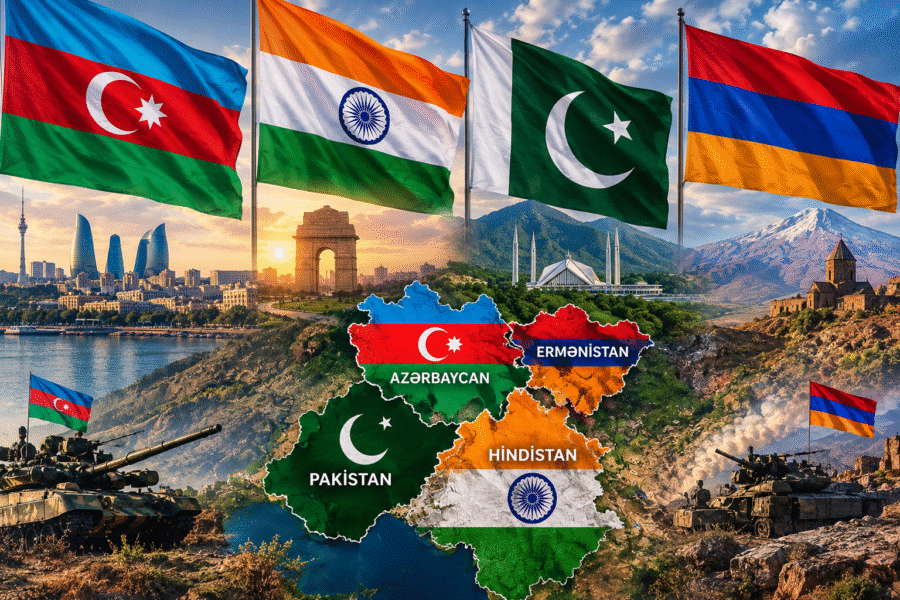
Are real steps being taken towards normalising relations between Baku and New Delhi? How would Azerbaijan’s possible rapprochement with India affect its strategic partnership with Pakistan?
Speaking to Globalinfo.az, MP Bahruz Maharramov said Azerbaijan’s expansion of diplomatic contacts with India and steps to relatively ease tensions with official New Delhi do not represent a change in the strategic course of foreign policy, but are a logical manifestation of the country’s sovereign, multi-vector and pragmatic diplomatic doctrine:
“India’s intensive arming of Armenia after the Second Karabakh War and the formation of the Yerevan-New Delhi-Athens axis had created a serious chill between Baku and New Delhi. However, recent developments, particularly official meetings and mutual contacts at foreign minister level, show that both sides are inclined to replace sharp ideological and military-political confrontation in their relations with economic and logistical pragmatism. Legally and politically, it is more accurate to view this process not as ‘warm relations’ but as a stage of normalising relations and establishing a functional partnership. Azerbaijan’s geostrategic position, particularly its role as a key link in the International North-South Transport Corridor, makes it an indispensable route for India to access the markets of Central Asia, Russia and Europe. New Delhi understands well that it is impossible to implement effective geo-economic projects in the region without taking into account the reality of a strengthening Azerbaijan in the South Caucasus. For Azerbaijan, India is important as a major economy, an important trade partner and a potential buyer of hydrocarbon resources.
At the same time, these diplomatic manoeuvres strengthen Baku’s position in the Azerbaijan-Armenia peace process. Establishing direct dialogue with India is an important foreign policy tool to neutralise New Delhi’s unilateral and large-scale military support for Armenia, or at least keep that support within limits that do not disrupt the balance.”
The MP said Pakistan is not expected to react negatively to these diplomatic contacts or express concern:
“There are several undeniable political, legal and strategic reasons for this. First of all, there is strategic alliance and confidential trust: relations between Azerbaijan and Pakistan are not ordinary diplomatic ties but are at the level of a strategic alliance enshrined in declarations and agreements. Pakistan is among the states that have provided the most consistent and unconditional support for Azerbaijan’s territorial integrity and sovereignty during and after the Second Karabakh War. Baku and Islamabad have the highest level of coordination in military, military-technical, intelligence and security fields. Azerbaijan’s economic or transit dialogue with India does not, and cannot, undermine these strategic military-political pillars of its relations with Pakistan.

Bahruz Maharramov
There is also the principle of sovereign foreign policy and ‘compartmentalisation’. In line with the principle of sovereign equality under international law, both Azerbaijan and Pakistan have the right to pursue fully independent foreign policies. Pakistan’s foreign policy has a similar model: just as Pakistan’s close strategic alliance with China does not hinder its relations with other powers, Azerbaijan’s establishment of economic contacts with India within the framework of its national interests is met with understanding by Islamabad. In diplomatic practice, states are able to separate their economic and transit interests from ideological and security issues.
Moreover, Azerbaijan has so far defended Pakistan’s just position on the Kashmir issue on all international platforms, in accordance with the norms and principles of international law and United Nations Security Council resolutions, and this policy remains unchanged. Since the restoration of dialogue with New Delhi does not weaken Azerbaijan’s principled support, it does not create any political jealousy or mechanism of pressure on the Pakistani side.”
According to B. Maharramov, Pakistan‘s leadership understands well that Baku is the region’s main logistics and transport hub:
“India’s use of Azerbaijani territory within the framework of the North-South Corridor increases Azerbaijan’s geo-economic weight and international standing. Deepening ties with a strong Azerbaijan with broad geo-economic capabilities directly contributes to Pakistan’s strategic interests in the South Caucasus and Central Asia.
In other words, the current dynamics in Azerbaijan-India relations run counter to the interests of none of Baku’s strategic partners. This is part of Azerbaijan’s strategy to completely isolate Armenia geo-economically, dictate a peace architecture in the South Caucasus based on its own terms and diversify risks in foreign policy. The existing fraternal and strategic alliance relations with Pakistan are unshakeable, and pragmatic contacts established with New Delhi cannot cast any shadow over this alliance.”
Turan Rzayev
Globalinfo.az
Read also