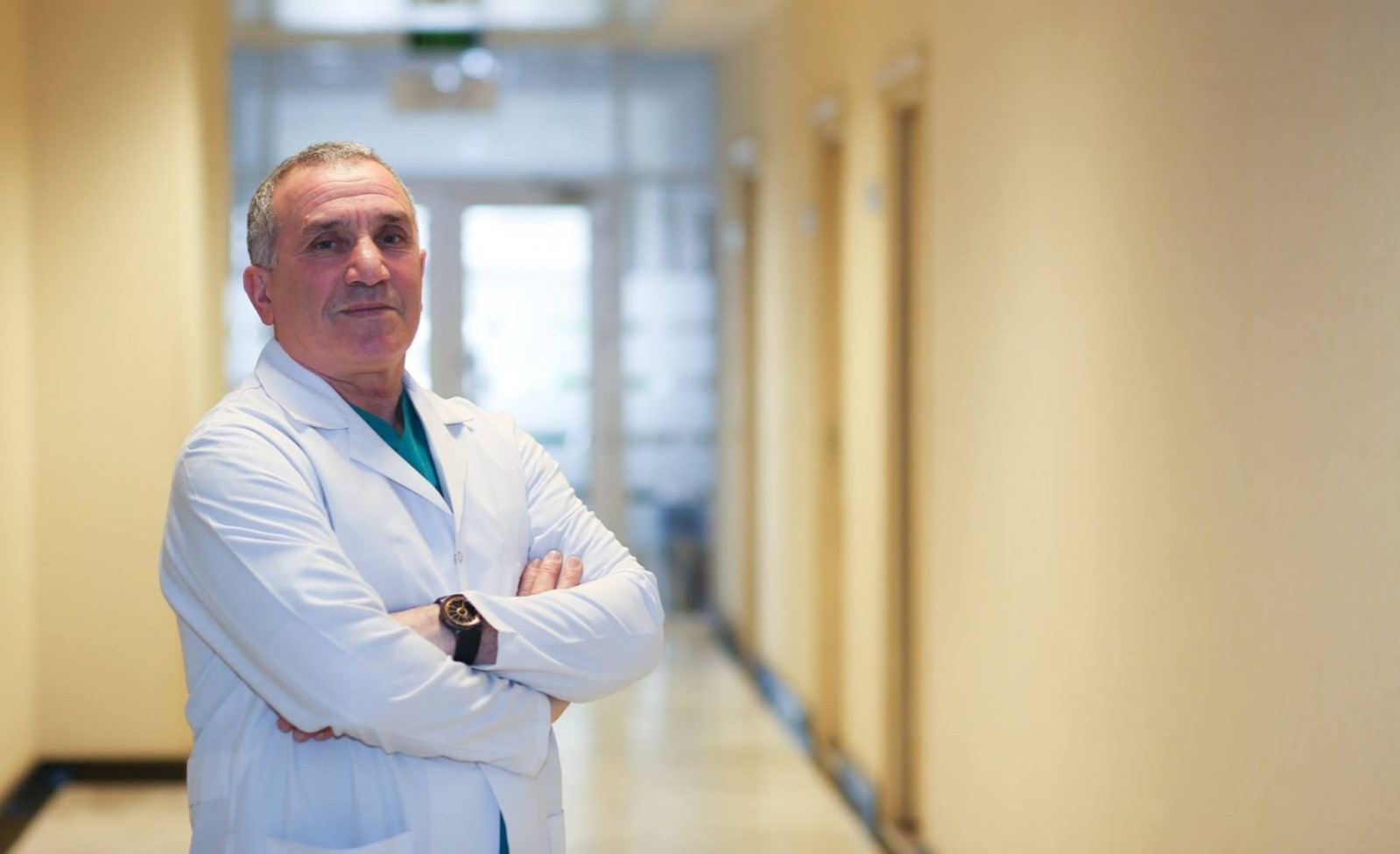
Well-known orthopedist-traumatologist, candidate of medical sciences, professor Bayram Qorçiyev spoke in an interview with Globalinfo.az about the difficulties they faced during the 44-day war, the operations they performed and the events that left a mark on his memory.
We present the interview:
– How do you remember the first moments of the 44-day war…
– What happened in 2020 is still before our eyes. We felt great pride and a sense of responsibility, and at the same time we were anxious. The proximity of the war, the wounded soldiers being brought in, their bleeding and the emotions they experienced are in my memory. Not one of them cried or showed his anxiety. On the contrary, they yielded to one another so that the more seriously wounded would be helped first. A soldier would say that his comrade-in-arms had a worse wound than his own, help him first. And a commander would put his own soldier’s treatment first. These were very proud moments.
The enemy used various tactics to prevent the evacuation of wounded soldiers. It was difficult to get them out of the combat zone during the daytime. During evacuation, ambulances and the wounded came under fire. That is why soldiers were brought to the Fuzuli Diagnostic Center, where we were, mainly at night. Sometimes we received 50-60 wounded at a time.
– How was the initial intervention on a wounded soldier carried out?
– As soon as the medical personnel received the patients, they assessed their condition, began initial interventions and organized the treatment process according to their specialities. Painkillers and antibiotics were administered, and the necessary measures were taken to prevent allergic reactions. The wounded were then sorted according to their condition and the medical care they needed. A maxillofacial surgeon, a vascular surgeon, a traumatologist, a therapist, an ophthalmologist, a radiologist – everyone worked in his own field. Within an hour or two, those in need of emergency surgery were sent to the operating room, the others were examined, and those in a state of shock were placed in the intensive care unit.
After a while the next 50-60 wounded would be brought in. Our work would only finish at 4-5 in the morning. Even so, we did not feel tiredness or hunger. Because there were people in front of us whose lives we had to save.
– Did you stay at the hospital during that period?
– We had taken a hotel in Beylagan and would go there to rest. Before even 10-15 minutes had passed, word would come that the next wounded had been brought in and we had to go back urgently. We returned to work again without even closing our eyes. Although we worked in very difficult conditions, we did it with great pride.
At first we thought that if we bandaged a wounded man’s wound and sent him on, he would receive better medical care further on. But experience showed that the evacuation of patients took one, sometimes two days. Time was lost while they were sent from one hospital to another, wounds suppurated, gangrene developed in the legs, and the condition worsened. Because along the way there was not always a doctor capable of providing qualified medical care.

That is why we decided that doctors should collectively provide the widest possible specialized medical care at the front line, at the first point where the patient was.
The treatment process was carried out like this…
We carried out all these interventions together at the front line. I fixed the bone, the vascular surgeon sutured the artery, the plastic surgeon restored the skin defect. The resuscitator brought the patient out of shock, and the neurosurgeon performed the necessary intervention. Thus the wounded received complex specialized medical care at the place where he was first admitted.
After that, there was no need to send patients whose condition had stabilized to military hospitals or to Baku’s central hospitals. We sent them to districts such as Shamkir, Ganja, Saatli, Zardab, and sometimes home.
– You said earlier that the wounded servicemen did not show their pain…
– We are used to our patients shouting, crying, being frightened and restless when they arrive. But we did not see this in our soldiers. When we asked them where they had been wounded, they would say “I was wounded in Shusha.” They were proud of being wounded in Shusha. Complaining of pain, crying, a sense of fear and anxiety were almost not observed.
We had a patient whom we hugged and carried from one place to another. Suddenly he said that he had not bathed for several days, that he smelled bad and was ashamed. And I replied that the most beautiful scent came from him, that he gave off the scent of paradise, of heaven, of flowers. You are a hero! They treated one another very sincerely, waited for one another and supported one another.
– What other memory can you share?
– Once a soldier was brought in at night. He said that one eye was not seeing, that it had come out. Since the eye is a special area, we approached this matter carefully. We cleaned his eye of mud and other dirt. It turned out that there was no damage to the eye at all, the mud had simply covered it completely. It looked as if he had lost his eye. When we saw that his eye was in place and undamaged, we were all very happy.
We came across an incident in which Armenians poured poison into food they kept in houses in order to poison our soldiers. Five soldiers fell into a coma. We contacted the center and sent them urgently to the Baku Toxicology Center. Doctor Azar helped us a lot. He both gave advice from a medical point of view and provided support for organizing the treatment of the patients. We contacted him, acted in coordination with the emergency service staff and delivered the patients to the Toxicology Center. As a result, all of them were saved. Yet their condition was very serious and they had been subjected to severe poisoning.
Zaira Akifqızı
Globalinfo.az
Read also