Today, 9 November, is Azerbaijan’s State Flag Day. The history of Azerbaijan’s tricolor flag goes back to 1918, to the emergence of the Azerbaijan Democratic Republic (ADR), one of the first parliamentary republics in the East. But the flag’s ideological foundations had been shaped earlier. In the late 19th and early 20th centuries, the issues of national identity, Turkism, Islamic solidarity and the building of a modern society took an ever wider place in Azerbaijani socio-political thought.
Prominent Azerbaijani thinker Ali bey Huseynzade played a special role in shaping this ideological line. The idea he put forward — “Turkization, Islamization, Europeanization” — later became one of the main strands of Azerbaijani national statehood thinking. It was these three principles that came together in the ideological philosophy of the tricolor flag.
The first adoption of the tricolor flag
On 28 May 1918, the creation of the Azerbaijan Democratic Republic was declared. One of the main tasks facing the new state was to define the attributes of national statehood. Within that framework, the first state flag was also adopted.
On 21 June 1918, the government of the Azerbaijan Democratic Republic approved as the state flag a red banner bearing a white crescent and an eight-pointed star. But this was not the tricolor flag we know today.
In November of that year, the question of state symbols more fully expressing the national ideology came back onto the agenda. As a result, on 9 November 1918, by decision of the government of the Azerbaijan Democratic Republic, a tricolor flag made up of blue, red and green was adopted. Thus began the history of the main symbol of Azerbaijani statehood that is still in use today.
What do the colors of the flag mean?
The Azerbaijani flag consists of three equal horizontal stripes: blue, red and green. Each color carries a specific national, political and spiritual meaning.
Blue expresses the Turkic origin of the Azerbaijani people, their belonging to the Turkic world and their national identity.
Red symbolizes the desire to build a modern society, achieve progress and develop democracy.
Green expresses the Azerbaijani people’s belonging to Islamic civilization.
The combination of these three colors in one flag was no accident. Here the ideas of national identity, religious and spiritual values and modern state-building were brought together in a single concept. In this sense, the tricolor flag was not only a visual state attribute, but also an expression of the ideological program of the Azerbaijan Democratic Republic.
The white crescent and eight-pointed star placed in the middle of the flag’s red stripe are also its integral elements. The crescent is recognized as a symbol of Islamic culture. Various interpretations exist regarding the origin and symbolic explanation of the eight-pointed star. One widespread explanation links it to the fact that the word “Azerbaijan” is written with eight letters in the Arabic script.
1920: The flag is lowered and independence is lost
The Azerbaijan Democratic Republic lasted only 23 months. On 27 April 1920, as a result of military intervention and political pressure by Bolshevik Russia, the Republic collapsed. On 28 April, Soviet power was established in Azerbaijan.

That put an end to the existence of the tricolor flag as a state symbol. On 3 May 1920, the tricolor flag was lowered from the building of the Azerbaijani parliament.
During the years of Soviet rule, Azerbaijan’s state flag was changed several times. After 1920, red Soviet flags were used. In 1952, a new state flag of the Azerbaijan SSR was approved. That flag consisted of red, blue and green stripes, with a hammer, sickle and five-pointed star in the upper left corner. However, the ideological content of that flag was entirely different from the tricolor flag of the Azerbaijan Democratic Republic.
Nevertheless, the tricolor flag was not erased from the people’s national memory. The idea of independence was kept alive in various periods through the activity of intellectuals, emigrants and nationally minded people. In particular, representatives of the Azerbaijani emigration, including Mahammad Amin Rasulzade, preserved the statehood heritage of the Republic and the meaning of the tricolor flag.
Rasulzade’s words — “A flag that rises once will never fall again!” — also became one of the most powerful symbols of this historical memory.
1990: The flag flies again
In the late 1980s, as Azerbaijan’s independence movement gained strength, the tricolor flag again became one of the main symbols of the national liberation struggle. From 1988 onward, the tricolor flag began to be raised at rallies held in Baku and in various regions of Azerbaijan.
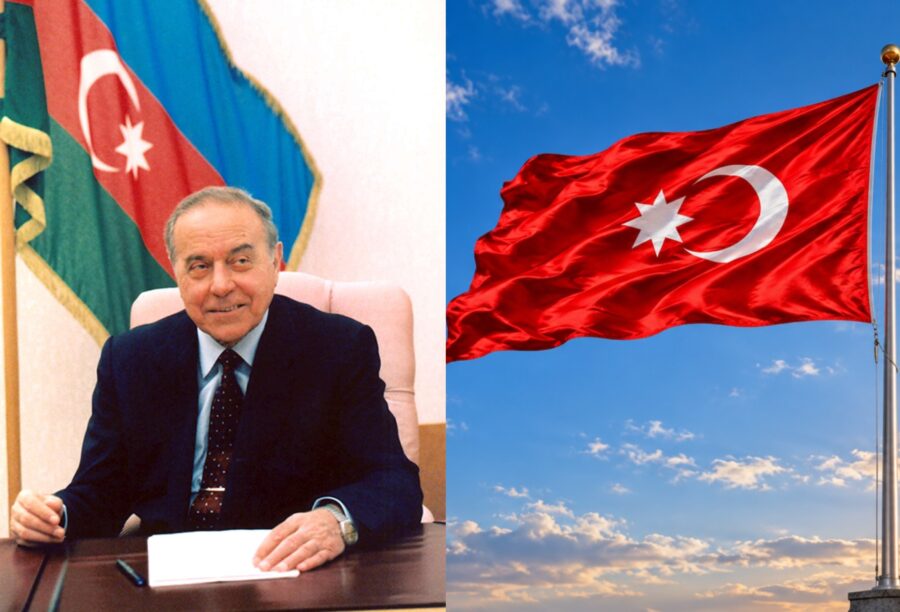
On 17 November 1990, at a session of the Supreme Assembly of the Nakhchivan Autonomous Republic, the tricolor flag was again adopted as the state flag. The session was chaired by Heydar Aliyev, chairman of the Supreme Assembly. At the same time, a petition was raised before the Supreme Soviet of the Azerbaijan SSR to recognize the tricolor flag as the state symbol for all of Azerbaijan.
This decision was an important event in the history of Azerbaijani statehood. Because at a time when Soviet power still existed, the flag symbolizing Azerbaijan’s independent statehood heritage was officially restored.
On 5 February 1991, the Supreme Soviet of the Azerbaijan SSR decided to adopt the tricolor flag as Azerbaijan’s State Flag. Thus the flag lowered in 1920 regained state status 71 years later.
On 18 October 1991, the Constitutional Act on the state independence of the Republic of Azerbaijan was adopted. The tricolor flag had already restored its historical place as the statehood symbol of independent Azerbaijan.
The flag of independent Azerbaijan and its statehood status
After Azerbaijan restored its state independence, the legal status of the tricolor flag was strengthened. Under Article 23 of the Constitution of the Republic of Azerbaijan, the State Flag, the State Emblem and the State Anthem are the state symbols of Azerbaijan.
The Constitution establishes that the State Flag consists of three horizontal stripes of equal width, with the upper stripe blue, the middle stripe red and the lower stripe green. In the middle of the red stripe are a white crescent and an eight-pointed star. The ratio of the flag’s width to its length is 1:2.
On 17 November 2009, by decree of President Ilham Aliyev, 9 November was declared State Flag Day in Azerbaijan. Since that date, 9 November has been marked every year in our country as a day dedicated to the state flag.

Prepared by: Turan Rzayev
Globalinfo.az political writer
Read also