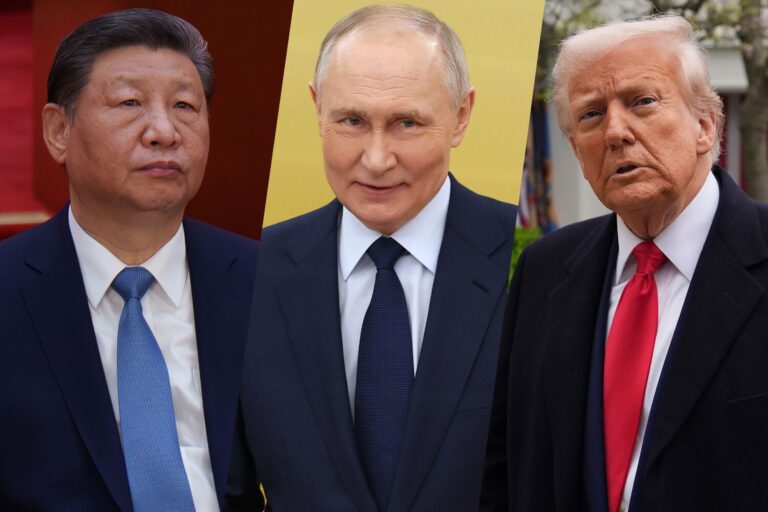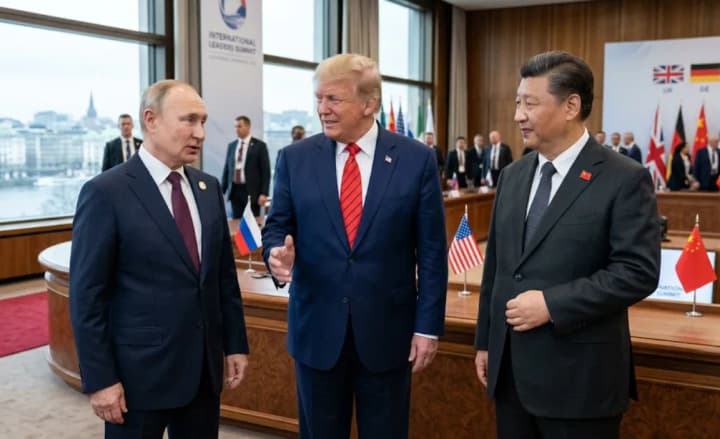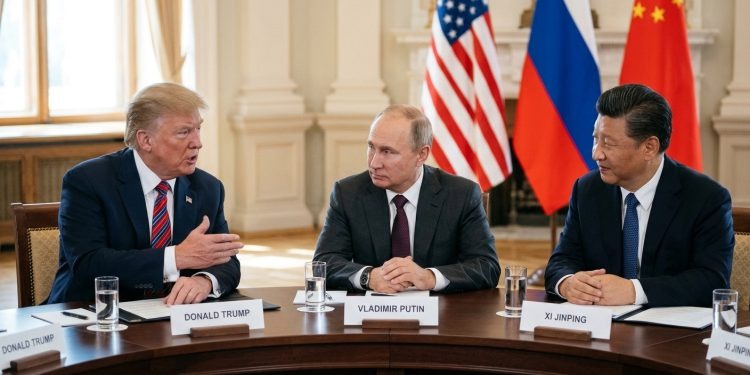
Reports have been confirmed that a trilateral meeting between US President Donald Trump, Chinese leader Xi Jinping and Russian President Vladimir Putin will take place at the Asia-Pacific Economic Cooperation summit to be held in China this week.
A few days ago, US Secretary of State Marco Rubio and Chinese Foreign Minister Wang Yi held a telephone conversation. They set out the topics the leaders will discuss in China. The leaders’ meeting is expected to address, along with various other issues, the Russia-Ukraine war and the tensions surrounding Iran.
Speaking to Globalinfo.az, political analyst Aytan Gurbanova said the trilateral meeting has become one of the main discussion topics of international politics:
“The telephone call between Marco Rubio and Wang Yi on the eve of the meeting and the agreement of the agenda for discussions at the leaders’ level is an important moment showing the intensity of diplomatic contacts. The significance of this meeting carries a broader meaning than the mere gathering of the leaders of three major states. Because relations between the US, China and Russia have a direct impact on the international security system, the global economy and the regional balance of power. At present, Washington is striving to defend its positions in economic and technological competition with China, Moscow to reduce its political isolation in relations with the West, and Beijing to consolidate its growing economic and political weight in the international system. Against the background of these differing interests, trilateral dialogue is important both for managing the risks of confrontation and for identifying the possibilities for possible agreements.
One of the main discussion tracks of the meeting may also be the Russia-Ukraine war. While Washington is trying to expand diplomatic opportunities to stop the conflict, Moscow is interested in having its security and political demands taken into account. China, while preserving its strategic partnership with Russia, is also trying to take into account its economic relations with Europe and its international prestige. However, reaching agreements on Ukraine’s future without Ukraine’s participation could weaken the prospects for a lasting peace. Because a resolution of the conflict may be possible not only through a ceasefire, but with Ukraine’s sovereignty and security guarantees taken into account.”

Aytan Gurbanova
The political analyst noted that the tensions surrounding Iran may also occupy an important place in the three leaders’ discussions:
“The US approach to Iran’s nuclear programme and regional activity, Russia’s political-military cooperation with Tehran, and China’s energy and economic interests form differing positions on this issue. In particular, a disruption of security in the Strait of Hormuz could have a serious impact on world energy markets and international trade. Precisely from this point of view, the parties, despite all their differences of opinion on the Iranian issue, have common interests in preventing regional escalation.
Another important issue is nuclear security and control of strategic armaments. The expiration of the New START treaty between the US and Russia in February 2026 has increased the need for new mechanisms in the field of limiting nuclear weapons. Washington is interested in China also joining this process. However, the fact that Beijing’s nuclear arsenal is considerably smaller than the arsenals of the US and Russia makes it difficult for it to join the negotiations on the same terms. This contradiction shows that, in order to ensure strategic stability, the parties’ security interests and the existing balance of forces must be taken into account.
In the final analysis, the main significance of the Shenzhen meeting lies not in eliminating all the contradictions between the three states, but in managing competition and identifying common approaches on global security issues. And any agreement reached between the major powers can produce lasting results only if it is based not only on the balance of power, but on international law, the sovereignty of states and consideration of mutual interests.”
Turan Rzayev
Globalinfo.az
Read also