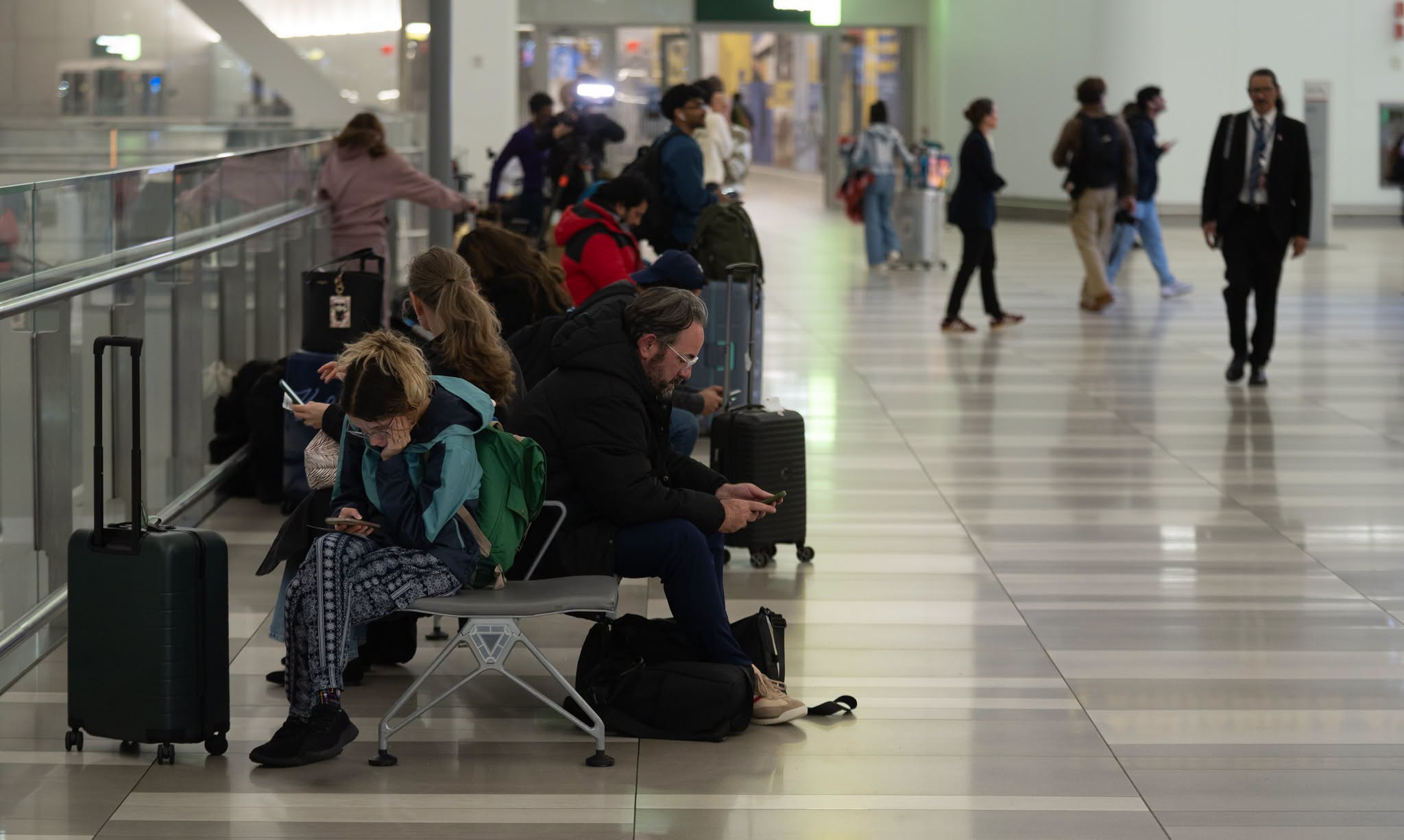
A major disruption to air transport operations in the United States on November 13 has triggered various claims and concerns. Social media users have suggested the incident may be linked to a terrorist threat, a cyberattack or the possibility of a new pandemic.
How realistic is the possibility that the incident was linked to terrorism or a cyberattack? Is there any basis to claims about a new virus?
Speaking to Globalinfo.az, Doctor of Medical Sciences and Professor Adil Geybulla said very strange processes are currently unfolding in the world:
“The US-Iran, Gulf and Ukraine-Russia wars are taking place amid a clash of interests among global powers. These conflicts are accompanied by numerous provocations, cyberattacks and various hybrid attacks. At times, it is impossible to fully clarify the causes of these events. According to official information on the suspension of all flights in the United States, the problem was related to software. A malfunction occurred at the central unified software hub used to manage flights, and a number of pieces of equipment need to be replaced to update the system. This requires a substantial amount of funding. Although a temporary solution has been achieved, more than $50 billion is reportedly needed to resolve the problem permanently. Congressional approval must be obtained to allocate those funds, after which the necessary work must be carried out.”
Adil Geybulla
The professor noted that other factors may also be behind the incident:
“Some time ago, an incident involving the plague bacillus occurred in Russia’s Irkutsk region, and a female laboratory employee died. Reports later emerged that it was an attempt involving a biological weapon. However, all details of the incident remain unclear, and official information on the matter has been limited. Such attempts cannot be ruled out. Dangerous and especially dangerous infections can be used as biological weapons. Various means are being sought to influence the course of war or bring it to an end. Naturally, states engaged in war have their own interests and, accordingly, may take various steps both domestically and against the other side. It appears that the world is currently undergoing a process of redistribution and the formation of a new order. The main issue in this process is a clash of interests. People, the Earth, the atmosphere and our planet as a whole bear the burden of all this.”

Farid Musayev, head of the IT department at Khazar University and an expert at the Azerbaijan Cybersecurity Organisations Association Public Union, said this was the longest nationwide flight restriction since the September 11, 2001 attacks:
“Although the restriction was lifted at 20:15 that day, its consequences continued throughout the weekend. More than 9,000 flights were cancelled on Friday and more than 5,000 on Saturday. The possibility of a cyberattack is currently assessed as low, but it has not been completely ruled out. US officials said there was no evidence of a foreign cyberattack. The FBI and NSA were involved in the investigation, while specialists from Cisco and Juniper also took part in technical inspections. The signs point more to a technical malfunction. No data loss, system encryption or ransom demand was recorded. The network was overloaded, and operations resumed after the source of the problem was isolated.”

Farid Musayev
The expert added that the FTI network used by the Federal Aviation Administration (FAA) is a complex system in which legacy and modern technologies operate together:
“This network connects more than 4,400 facilities and thousands of telecommunications services. The problem may have arisen in the interaction between newly installed routers and the legacy system. Under normal circumstances, the impact of such a malfunction should remain limited. However, this incident shows that mechanisms for isolating faults in the network are insufficient. A similar incident was recorded on the FAA network in 2009. At that time, the system encountered a problem as a result of the dissemination of incorrect routing information.
This incident has highlighted several important issues in managing major infrastructure systems. When new equipment is installed, its potential scope of impact must be assessed in advance and its compatibility with legacy systems must be checked. Mechanisms that prevent a malfunction from spreading to other sections must also be tested. Another important issue is whether monitoring systems can identify the source of a problem in a timely manner. Failure to replace ageing equipment not only creates difficulties in IT, but also increases the risks of large-scale failures and security threats.”
Laman Imran
Globalinfo.az
Read also