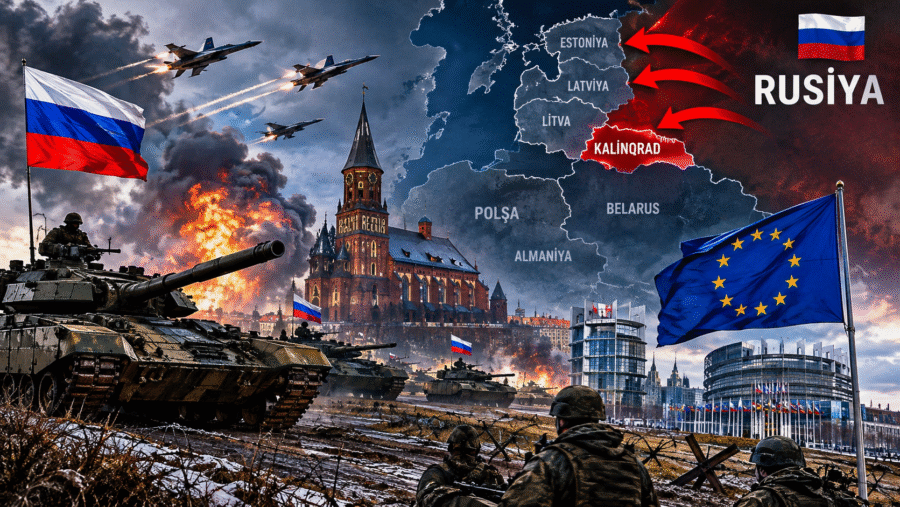
Tension has not eased since the explosion in the waters of the Gulf of Finland on 21 November. Experts see it as a signal that a new era has begun in Northern Europe’s security architecture.
The cargo ship Sparta II, heading towards Russia’s Kaliningrad exclave, became a drone target. The strike occurred just 3 nautical miles from the Russian border. The Russian Foreign Ministry reacted sharply to the incident, declaring that a “resolute and devastating” response would be given. Nevertheless, Moscow is so far refraining from direct military escalation.
Why is the Baltic Sea becoming the next “hot spot” after the Black Sea or the Middle East?
Speaking to Globalinfo.az, political analyst Rustam Tagizade said that, according to the DDE model, every major crisis begins with a small “shock”:
“The drone strike on the Sparta II is that ‘shock’. But the point to focus on is not the strike itself, but the chain reaction it produces.
This attack is a direct blow to Russia’s military-logistics line. For a military fortress squeezed between Poland and Lithuania, the sea route is of vital importance. The incident showed that Russia’s supply routes to Kaliningrad are no longer fully secure.
The shock wave immediately moves into the transmission phase. The North Atlantic Treaty Organization (NATO) is stepping up surveillance within its “Baltic Sentry” mission. Russia’s “shadow fleet” vessels are being subjected to tougher checks at Western ports. As a result of this mutual pressure, the risk of war in the Baltic rises sharply and international trade routes slow down.
But this is not an isolated incident. Just a day later, on 22 November, the Merkuri corvette of Russia’s Black Sea Fleet was seriously damaged, presumably in an attack by Ukrainian naval drones, and destroyed in a large explosion in Libya’s Benghazi port. The strikes at these two distant points show that for Russia the front line is no longer opening only on Ukrainian territory, but also at all strategic points where its maritime supply and military presence exist.”

Rustam Tagizade
The political analyst noted that Russia’s state-aligned media and Telegram channels, as well as analysts close to the Kremlin, claim that the West has long been preparing European society for a direct clash with Russia:
“Russian experts interpret the West’s strategic communications (for example, statements by figures such as En Enplbaum) as Europe being accustomed to “drone and missile warfare”.
According to Russia’s official position, Finland, Sweden and the Baltic states, under London’s influence, have begun blockading Kaliningrad, while Germany has launched mass drone production against Russia. Moscow believes that these processes are driven not by NATO‘s Article 5, but precisely by hybrid scenarios.
States do not simply fear an adversary’s overall power; what frightens them most is geographic proximity and intentions. For Russia, the fact that strategic centres such as St Petersburg and Kaliningrad lie close to NATO member Finland and the Baltic states creates a serious threat balance. For the West, Russia’s cutting of undersea cables, jamming of GPS systems and disruption of security through its “shadow fleet” is an equally serious threat.
Since both sides perceive each other’s steps not as “defence” but as “preparation for attack”, the risk of miscalculation grows day by day.”
Turan Rzayev
Globalinfo.az
Read also