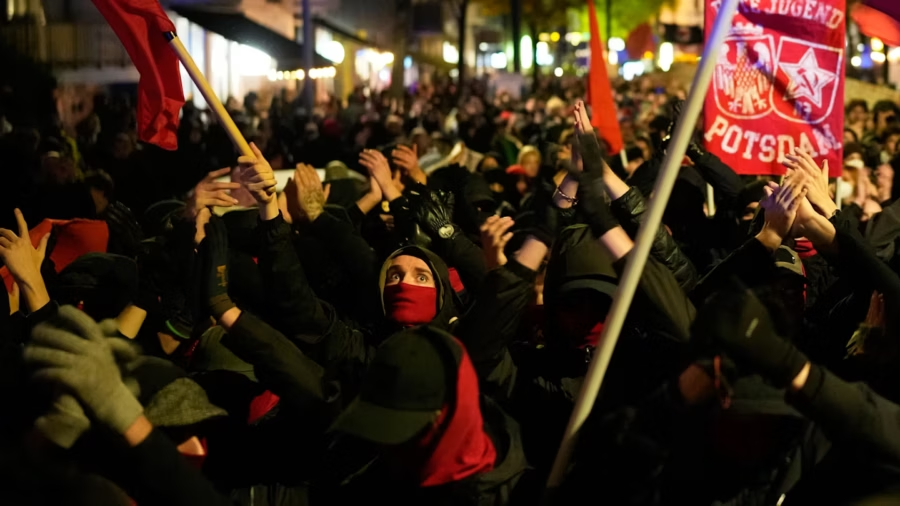
Protest actions have spread widely across many European countries. The driving force in this process is largely young people — more precisely, Generation Z.
In France, Germany, Italy, Belgium, Albania and other countries, young people have taken to the streets. Their demands differ, but what unites them is dissatisfaction with the existing political and economic system.
In fact, it was expected that Generation Z’s protest wave would reach Europe sooner or later. The first serious signals had already emerged back in 2025. At that time, young people in various regions of the world organised through social networks and launched mass protests against authorities, indicating that a new political trend was taking shape.
The protests that began in Nepal
The events in Nepal in September 2025 are particularly significant in this regard. On September 4, the government’s imposition of restrictions on access to social media platforms further fuelled young people’s discontent. The protests that began in Kathmandu and other cities on September 8 quickly turned into large-scale anti-government actions. Young people protested against corruption, nepotism, unemployment, economic inequality and the indifference of the political elite to society’s problems. The harsh intervention of security forces against demonstrators, numerous casualties and incidents of violence further escalated the situation.
As a result, on September 9, Prime Minister KP Sharma Oli was forced to resign. Thus, the protests in Nepal, with Generation Z at the forefront, led to a change of power. This event showed that young people organised through social networks and unaffiliated with traditional political structures can quickly become a major political force.
The Madagascar events
Just a few weeks later, on September 25, a similar process began in Madagascar. The reason for the first protests was the regular cutting of electricity and drinking water. However, the discontent quickly took on a broader character. Young people began to oppose high living costs, unemployment, corruption, nepotism and the government’s governance policies.
The protests expanded further with the organisation of a youth movement calling itself “Gen Z Madagascar” on social networks. On September 29, President Andry Rajoelina dismissed the prime minister and the entire government. But this step did not calm the demonstrators. On the contrary, protesters began demanding the president’s resignation. On October 11, one of the army’s special military units sided with the protesters and turned against the president. On October 13, Rajoelina announced that he had fled the country, and on October 14 the military announced that they had seized power. As a result, President Andry Rajoelina was removed from power, and Colonel Michael Randrianirina became the key figure in the country’s new political administration.
Leap to Europe
I noted at the time as well that these processes should not be assessed merely as local protests occurring in individual countries. The Nepalese and Madagascar examples were, in a certain sense, early signals showing how serious a test new-generation protests could become for political systems.

Serbia became one of the most notable examples of this process in Europe. On November 1, 2024, the collapse of the roof of a railway station in the city of Novi Sad, which claimed the lives of 16 people, caused widespread public discontent in the country. Questions about responsibility for the incident, corruption and the functioning of state institutions gave impetus to the start of student protests.
From the beginning of 2025, demonstrations led by students spread to hundreds of cities and towns in Serbia. Protesters demanded that those responsible be punished, corruption-related documents be disclosed, state institutions be held accountable and early parliamentary elections be held. On January 28, Prime Minister Miloš Vučević resigned. However, this did not halt the protests.
The process continued in 2026. Finally, in the parliamentary elections held on October 25, the list backed by the student movement won 53.7 percent of the vote and 141 of the 250 seats in parliament. The list of the Serbian Progressive Party, led by President Aleksandar Vučić, gathered 39.5 percent of the vote. This brought to an end the rule of the governing party, which had held a dominant position in the country’s political administration for 14 years. Thus, in Serbia, student protests turned into a political process stretching from street actions to an election victory.
Attention is now turning to other European countries. Large-scale actions involving young people are being held in France, Germany, Italy, Belgium, Albania, Portugal and other countries.
In France, the main reasons for the protests are problems in the education system, rising living costs, declining housing affordability and young people’s concerns about the future. In Germany, tens of thousands of people took part in actions held in more than 30 cities on October 31. Along with demanding more funding for education, healthcare and social security, young people also oppose the reintroduction of compulsory military service. Similar discontent is observed in Italy and Belgium. In Albania, students are holding demonstrations against the government over corruption, unemployment and education problems.
Same action, different reason
Interestingly, the specific reasons for the protests differ in all these countries. In one country the problem is housing prices, in another education, in yet another corruption and unemployment. But the underlying discontent stems from the same source. That is, political elites are unable to respond to the expectations of the new generation. They either try to silence the protests by force or delay the process with cosmetic changes. But what is visible is that the new generation’s discontent has long since exceeded the level that can be eliminated by individual decisions.
Generation Z’s capacity to organise independently of traditional political organisations, parties and ideological centres is striking. To put it more simply, information spreads within seconds, calls for protest reach thousands of people in a short time, and events in individual countries become an example for other societies. What happened in Nepal served, in a certain sense, as an experience for Madagascar, and what happened in Serbia for young people in other European countries. Their learning from one another, their use of similar protest methods and their influence on each other through social networks is already an undeniable trend.
In my view, there is sufficient ground for these processes to expand further in the period ahead. Particularly in countries with high economic difficulties, political tension, corruption, social inequality and public distrust, Generation Z’s protests could produce more serious political consequences. Because this generation, unlike previous generations, does not intend to reconcile itself with the existing situation and wait years for changes.
In my judgment, we are not simply observing young people’s protests in individual countries. This is about the confrontation of a new generation with the old political and social order. It is not possible to determine fully right now what consequences this confrontation will produce. But one point is clear. Managing the expectations of the new generation with the political methods of previous generations is becoming increasingly difficult.

Turan Rzayev
Political writer for Globalinfo.az
Read also