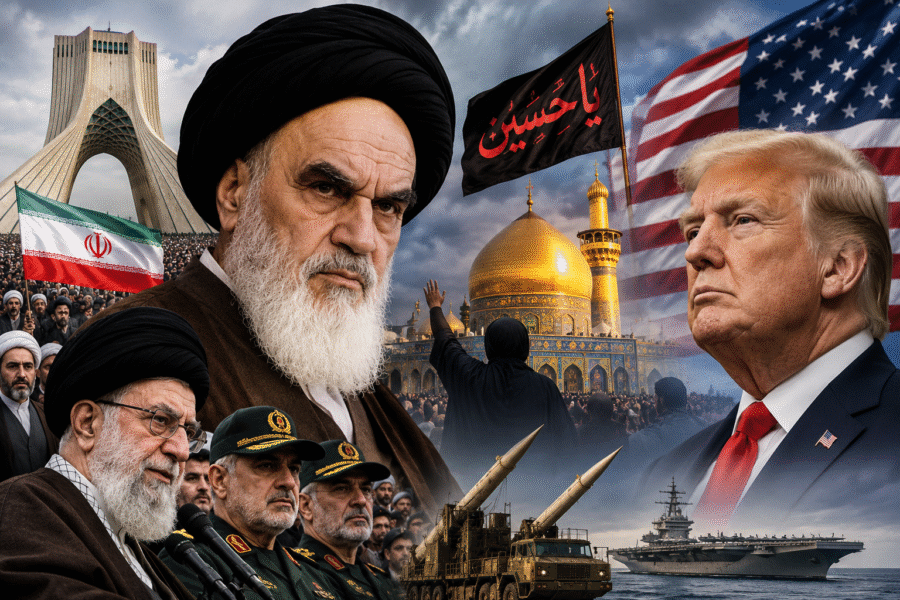
US-Iran tensions have persisted for a long time. It is no secret that plans are being drawn up in Washington for various options to bring Iran to heel. So far, however, these plans have produced no tangible results. Although Washington has cornered Tehran with economic sanctions, Iran has responded by carrying out missile and drone attacks in the Strait of Hormuz, disabling tankers. US President Donald Trump has said that Washington controls the Strait of Hormuz, but attacks on tankers show that the situation is different.
On the other hand, Iran’s efforts to restore its ballistic missile capability and expand its production capacity pose a separate security problem for Washington. Although US and Israeli military strikes have seriously damaged Iran’s military infrastructure, they have failed to permanently disable the country’s missile programme. Tehran is seeking to rebuild its military production capacity, improve existing technologies and restore its deterrence capability.
The situation on the nuclear issue is also not as Washington would like. There is no confirmed information on the scale at which Iran is currently continuing uranium enrichment. The International Atomic Energy Agency (IAEA) cannot fully verify the current status of the country’s enriched uranium stockpile because its access to Iran’s nuclear facilities and materials has been restricted.
Iran’s main “weapon”
Economic sanctions alone are generally insufficient to bring down the regime in Iran. Shaking the regime where it is strongest — in its ideological and theological foundations — is an approach that could yield more lasting results.
A key feature of the political system of the Islamic Republic of Iran is that religion is not merely an institution regulating the spiritual life of society. It is one of the main tools used to legitimise state power, justify political decisions, define the ideological framework of the security system and present the country’s foreign policy. The doctrine of Velayat-e Faqih, formulated by Ruhollah Khomeini after the 1979 Islamic Revolution, has formed the ideological foundation of this system. It has bound religious and political authority so closely that any serious challenge to the regime’s political legitimacy also makes its religious foundations a subject of debate.
In general, the first priority should be to weaken Iran’s position as the sole and undisputed religious-political centre of the Shiite world. For example, it is important to consider the Oman factor in relation to the Strait of Hormuz. Oman is a distinct regional actor for Iran not only because of its geographical position, but also because of its religious and political characteristics. Ibadism is one of the country’s main religious traditions. Ibadism is not a branch of either Sunni or Shiite Islam. It has its own religious-political history, concept of the imamate and approach to the legitimacy of power.
Ibadis link the legitimacy of power not to membership of a particular lineage or tribe, but to justice, adherence to religious principles and leadership accepted by the community. In this respect, their understanding of the imamate and political authority differs significantly from that of Imami Shiism.

The Houthis supported by Iran in Yemen are another matter. Tehran uses the Houthis as an important ally in its regional policy. The Houthis belong to the Zaydi branch. Zaydism differs from Imami Shiism, particularly from Twelver Shiism, which forms the basis of Iran’s state ideology. Zaydis do not accept the same succession of imams or the same belief system concerning the occulted twelfth imam as Twelver Shiites. Their understanding of the imamate rests on different historical and legal foundations.
This reality should be taken into account in the United States’ long-term strategy towards Iran. Tehran presents itself as the political and ideological centre not only of Iran but also of the broader Shiite world. However, the differing religious schools, concepts of the imamate and attitudes towards political power within the Shiite world show that this claim is not indisputable. Washington could use these differences to undermine Tehran’s influence in the Shiite world.
Tehran’s weak point
The second important issue is the system of religious authority within Iran itself. In fact, alternative centres of religious authority also exist within Iran. This is demonstrated by the differing traditions of the religious schools of Qom, Mashhad and Najaf, the varying jurisprudential and political positions of senior ayatollahs, and disagreements over the role of religious leadership in state power. During Khomeini’s rule, a number of influential clerics opposed the doctrine of Velayat-e Faqih, and some of them faced pressure, restrictions and political isolation. This is a historical fact showing that Iran’s religious elite has never held a unified political position.
If society increasingly accepts alternative religious authority within Iran, the regime’s ability to present its rule as a divine and unchangeable political necessity could weaken. This is particularly significant for Iran’s younger generation, secular-minded segments of society and social groups dissatisfied with the existing religious-political system. For part of society, maintaining an attachment to religion does not necessarily mean accepting the existing state system. People can preserve their Shiite identity while rejecting the system of Velayat-e Faqih. Separating these two issues could deal a serious blow to the regime’s ideological monopoly.
In fact, this is also why the United States cannot mobilise ethnic minorities in Iran. Azerbaijanis, Kurds, Baloch, Arabs, Turkmens and other ethnic communities live in the country. The religious, cultural and political interests of these groups are not the same. For many years, Tehran has sought to keep various social and ethnic groups within a single political framework through a unified state identity and Shiite religious ideology. However, weakening the uniformity of religious ideology could also trigger a new phase in these groups’ relations with the central government. In particular, breaking the link created between religious identity and political loyalty to the state could limit the regime’s ability to influence society.
It is important to limit the regime’s military capabilities, but leaving its ideological foundations untouched creates conditions for the same problems to re-emerge in the long term. Missile infrastructure can be destroyed, military production facilities can be disabled and nuclear sites can be damaged. But as long as the mechanism of religious legitimacy of power remains functional, Tehran will seek to mobilise new resources, rally society and restore its regional influence.
Turan Rzayev
Globalinfo.az political writer