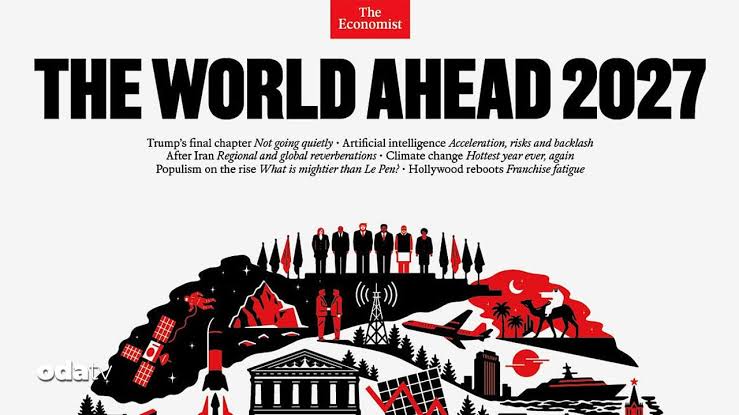
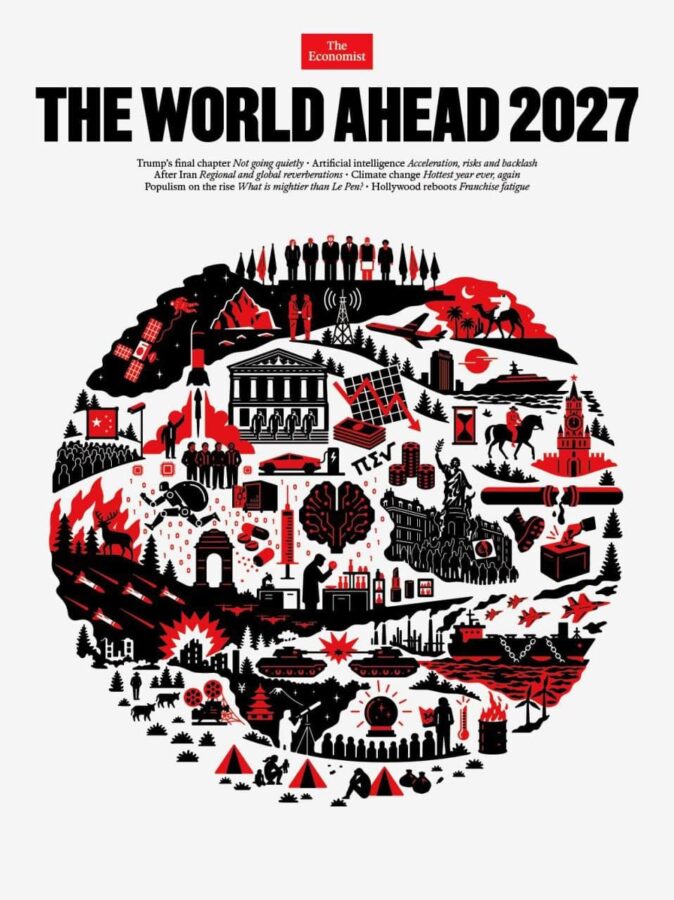
The Economist has unveiled the cover of its new issue, which features its traditional annual forecasts. The cover, which depicts what lies ahead for the world in 2027 and the individual crises and mutually reinforcing political, military, economic and technological confrontations, draws attention.
The first detail to draw attention is, of course, the composition dominated by black, red and white. It does not create an optimistic picture of the future at all. On the contrary, elements of danger, competition, control and uncertainty appear in almost every part of the image.
The artificial intelligence symbol placed at the center of the cover is particularly interesting. It can be read as a message showing that technology has ceased to be a separate sector of the economy and has become a major force affecting all areas, from politics to security and from the military industry to the labor market. On the one hand, AI promises to boost productivity and innovation; on the other, it accelerates a new technological arms race between states. The message here is who controls that technology and turns it into global advantage.
The images of military equipment, missiles, tanks and explosions placed around the AI symbol on the cover indicate that the security dilemma is growing in parallel with technological development. It is clear that modern wars are no longer waged only with manpower and conventional weapons. Drones, satellites, artificial intelligence, cyberattacks and information superiority have become integral parts of military strategies. In this regard, the magazine’s presentation of technology and war in the same composition does not seem accidental. It is not excluded that one of the main confrontations of the future will be precisely over the conversion of technological superiority into military and political power.
Political messages
Another notable element is the depiction of political leaders. The arrangement in a row at the top of the composition of figures reminiscent of several heads of state and government brings the importance of the leader factor in global politics to the fore. At the same time, images of buildings reminiscent of various political and state institutions, flags and large groups of people show that in the period ahead the struggle for power will continue not only at the level of international relations but also within countries. The political polarization of societies, attempts to influence election results, the rise of populism and declining trust in traditional political elites will remain a serious test for many states.
The placement on the right side of the cover of a structure resembling the Kremlin and a clock tower also deserves special attention. This image recalls Russia’s role in the global security architecture and the continuing nature of the confrontation between Moscow and the West. The inclusion of military equipment, missiles and explosions within the same image shows that the risk of war has not disappeared from the world agenda. Issues such as the consequences of the war in Ukraine, Europe’s security future, NATO-Russia relations and nuclear deterrence remain factors determining the future direction of the international system.
Military message
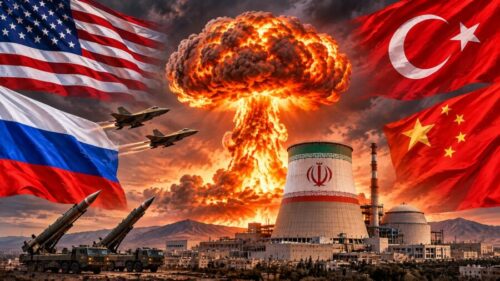
The abundance of missiles, warships, tanks and combat aircraft on the cover is a warning that the global arms race will accelerate further. As states increase defense budgets, the military industry becomes a larger part of the economy. The paradoxical side of this process is that countries that increase armaments to ensure security simultaneously expand mutual distrust and the scale of possible conflicts. In other words, military potential built up to preserve peace sometimes, instead of reducing the risk of war, starts a new era of armament among rivals.
Economic message
Bundles of money, charts, financial and industrial facilities, as well as energy infrastructure, show that the global economy cannot exist separately from political processes. The world economy is no longer explained only by production, trade and investment indicators. Sanctions, tariffs, the restructuring of supply chains, control over strategic raw materials and technological restrictions have turned economic relations into an instrument of geopolitical struggle. Competition between the United States and China, in particular, is one of the main directions of this trend. In the period ahead, the struggle for economic superiority expanding from semiconductors to artificial intelligence and from rare earth elements to energy resources is among the expected scenarios.
Energy message
Images related to oil, industrial infrastructure, fires and vehicles point to the transformation of the global energy system. Although the transition to renewable energy sources is accelerating, the strategic importance of traditional energy resources does not disappear. On the contrary, energy security continues to occupy an important place in states’ foreign policy. The main contradiction here is that the world, on the one hand, is advancing toward decarbonization targets, while on the other, owing to the needs of the economy and the military industry, it is unable to maintain its dependence on oil, gas and other conventional resources.
Environmental warning
The fires, destruction, displaced people and elements reminiscent of environmental disasters in the lower part of the image show that the future will not consist only of competition between major powers. Problems such as climate change, natural disasters, food and water security, migration and social inequality will shape a more complex agenda for international politics. In particular, intensifying competition for water and food resources could further deepen existing political tensions in some regions.
One of the interesting points is the inclusion in the composition of images reminiscent of scientific laboratories, medical preparations and biological structures. This suggests that healthcare and biotechnology will gain greater strategic importance in the future. After the pandemic, states have begun to take a more sensitive approach to biosecurity, drug production, medical technologies and the resilience of health systems. The development of biotechnology, on the one hand, creates opportunities that will change human life and, on the other, raises new ethical and security problems.
Turan Rzayev
Globalinfo.az political writer
Read also