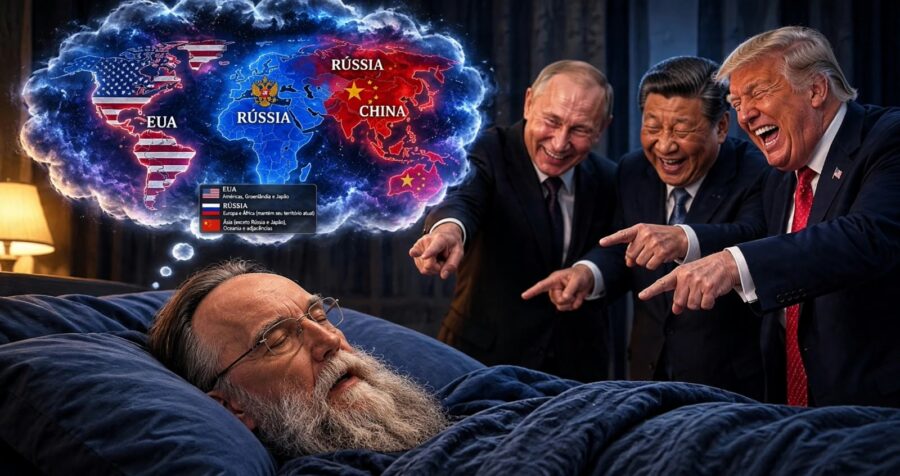
A map shared on social media by Russian public figure Aleksandr Dugin, one of the Kremlin’s main ideologues, has sparked debate. The map presents the United States, Russia and China as the main actors in the global order, assigning each a specific geographical area. With this map, Dugin clearly reflects the idea of multipolarity in international relations, more specifically his own “tripolar world model”.
For example, the United States is assigned the Americas, Greenland and Japan; Russia, Europe and Africa; and China, most of Asia and Oceania. In Dugin’s model, the position of small and medium-sized states as independent geopolitical actors is pushed into the background, while the geography in which they are located becomes part of the strategic calculations of major powers.
The timing of Dugin’s post was also no coincidence. He released the map on November 16, ahead of a trilateral meeting of the US, Russian and Chinese leaders scheduled for November 19 in Shenzhen, China. Dugin’s description of the meeting as a “tripolar world summit” shows the ideological framework through which he views the event.
In fact, I do not regard A. Dugin as a particularly serious figure. As he gets older, he is generally losing his mind. His latest post confirms this. In reality, Dugin’s post is nothing new. He has long sought to explain the world through three main civilisations and centres of power.
Apparent contradictions
In Dugin’s approach, the West, Russia and China represent different political and civilisational models. However, this classification contains major contradictions. Moscow and Beijing have for many years opposed Western global hegemony and called for a multipolar world. Yet Dugin’s model assigns other states not the role of equal participants, but rather that of choosing a position around these three centres. This conflicts with the concept of multipolarity. Put simply, if a unipolar world is criticised as US dominance and other states’ dependence on its political and economic influence, how different is a system divided into spheres of influence of three major states? In other words, replacing one hegemon with three does not automatically create a fair international system.
The geography assigned to Russia on Dugin’s map is itself full of contradictions. For example, portraying Europe and Africa as part of Russia’s sphere of influence reflects Moscow’s claim to be a leading power not only in the post-Soviet space but across a broader geographical area. Yet including Europe in Russia’s sphere of influence appears absurd against the backdrop of Moscow’s fundamental contradictions with the West. Russia is not a power capable of challenging or replacing the dominant position of the United States and NATO in the European security architecture. Most importantly, not all European countries agree to enter Russia’s sphere of influence.
The situation is no different for China. Dugin has assigned Beijing most of Asia, Oceania and surrounding areas. Clearly, this is a geopolitical vision that takes into account China’s rising economic, technological and military power. However, Asian states do not automatically accept Beijing’s regional dominance. The biggest omission is the India factor. India, the world’s most populous country, a major nuclear power and one of the leading members of BRICS, is not only absent as a separate centre of power but is shown as being under China’s influence. Yet India does not want to be fully part of the political orbit of Washington, Moscow or Beijing. New Delhi’s foreign policy is based on the principle of strategic autonomy. India cooperates with the United States in defence and technology, maintains relations with Russia and competes with China. Including it in China’s sphere of influence means ignoring India’s own geopolitical ambitions.
Divisive competition
In addition, the map takes the naive approach that the interests of China and Russia overlap unequivocally. In fact, both countries have economic and strategic interests in Central Asia. While Moscow sees the region as a historic security and sphere-of-influence space, for Beijing Central Asia is an important direction for energy security, trade, transport and the Belt and Road Initiative. For this reason, Dugin’s map differs considerably from the boundaries of real politics.
The map has thought-provoking aspects from Azerbaijan’s perspective. The South Caucasus is traditionally shown as part of Russia’s sphere of influence. Yet the Kremlin is weakening its influence and position in the region year by year. I would even say that the balance has shifted in Baku’s favour in this process. Put simply, Azerbaijan has signed strategic partnership agreements with the three powers on Dugin’s map. In addition, Azerbaijan cooperates with the United States on the TRIPP project, with Russia on the North-South transport route and with China on the Trans-Caspian project. In other words, the South Caucasus is no longer a region governed by previous geopolitical realities. Baku has also clearly stated that it does not want to fall within the sphere of influence of any centre of power.
In my view, this map does not depict the existing reality, but rather the world order desired by a particular geopolitical school. Such an order cannot go beyond wishful thinking.
Turan Rzayev
Globalinfo.az political writer
Read also