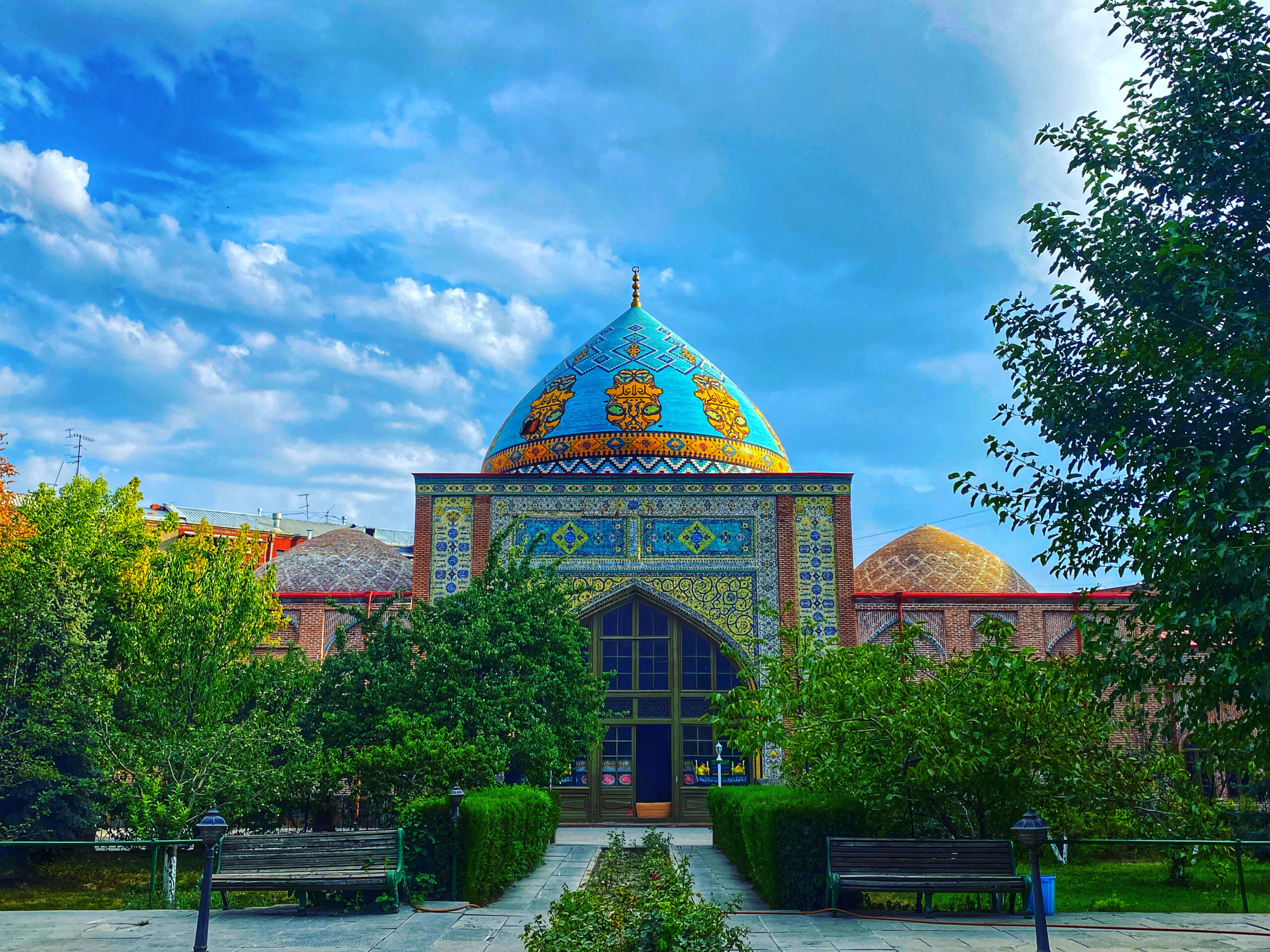
As is known, Iran’s Vice President Seyyed Hamid Pourmohammadi visited Armenia on November 8-10. During the visit, he attended a ceremony to name the ceremonial hall of the historic Blue Mosque in Yerevan, Armenia’s capital, after Armenian poet Yeghishe Charents. He also attended the unveiling of a commemorative plaque bearing the poet’s name. A bust of the poet is planned to be installed in the hall at a later stage.
The Iranian vice president’s action is Tehran‘s latest act of political hypocrisy. In fact, we have long become accustomed to such moves by official Tehran. However, given the current moment and changing conditions, this step requires a more detailed analysis.
The place named after Yeghishe Charents is not a school, library or cultural centre built by Iran in Armenia, but the ceremonial hall of the Blue Mosque itself. In other words, a mosque’s ceremonial hall has been named after a non-Muslim poet, and a plaque bearing his name has subsequently been placed there. If any non-Muslim country had done this, it could be understood to some extent. But the fact that Iran has taken this step sharply contradicts that country’s own religious values.
These contradictions become clearer when the issue is viewed through the principles of most Islamic denominations, including Ja’fari Shia jurisprudence, the official school of the Iranian state. There are restrictions even on decorating a mosque with gold. There are strict religious rulings concerning depictions, statues and bas-reliefs of living beings. At the same time, decorating mosques with images of living beings such as people and animals does not conform to Islam’s traditional religious and architectural practice.
However, considering that Iran turned a blind eye to Armenia keeping 20 percent of Azerbaijan’s lands under occupation for more than 30 years and remained silent as mosques more than 100 years old were turned into pig and cow farms, this step is not surprising either. Incidentally, this is the same Iran that loudly clamours over Al-Aqsa Mosque while, on the other hand, enabling the Blue Mosque to be turned into an Armenian cultural site.
Strange!
It is now necessary to look at both the history of the Blue Mosque and the identity of Armenian poet Yeghishe Charents, after whom the ceremonial hall was named.
Yeghishe Charents was born in Kars in 1897. He settled in Yerevan in 1919-1920 and later assumed an important position in the literary and cultural life of Soviet Armenia.
During the Soviet period, particularly in the 1920s and 1930s, the operation of religious monuments was restricted, a number of mosques and churches were closed, and some were used for other purposes. The Blue Mosque also lost its function as a place of worship during that period and began operating as the Yerevan Museum of History and Nature from 1937.
Interestingly, Yeghishe Charents also had a role in saving the Blue Mosque from demolition during the Soviet period. Along with a number of influential Armenian intellectuals, he opposed the demolition of the Blue Mosque at that time.

At first glance, this may sound like a highly humanitarian act, but the matter has more interesting aspects. As noted above, not only mosques but also churches were closed and demolished in those years. The religious activities of the Armenian Apostolic Church faced serious restrictions, and numerous churches were closed.
Had Yeghishe Charents and those he gathered around him protested only against the closure and demolition of churches, this initiative would naturally have won support mainly from Armenians. However, Armenians did not have influence in the Kremlin at that time. Therefore, they sought to win the support of Azerbaijanis in order to build broader protest and pressure.
Considering that more than 250,000 Azerbaijanis lived in the Armenian SSR at the time (the exact figure may differ), while there were more than 20 million Azerbaijanis in Iran, nearly 5 million in the Azerbaijani SSR, and large Azerbaijani communities in Georgia and Dagestan, this was not such an illogical approach. In other words, highlighting the preservation of the Blue Mosque to win Azerbaijani support in the struggle to protect Armenian churches was a well-considered and cunning move.
In one form or another, the Blue Mosque still exists in Armenia today. However, for many years it has been presented as Iranian heritage. Yet the Blue Mosque is part of Azerbaijan’s historical and cultural heritage. The mosque was built in the 18th century, during the Yerevan Khanate and the rule of Yerevan Khan Huseynali Khan.
What is Iran’s objective?
Iran’s objective must also be clearly understood. I believe Tehran wants to damage relations between Yerevan and Baku through this step. Tehran, long preoccupied with countering attacks by the United States and Israel, was unable to intervene in developments in the north. Yet Azerbaijan and Armenia were engaged in a successful negotiation process, meetings of delimitation and demarcation commissions were being held, messages delivered by the leaders at various international events were positive, and positive signals on peace were being sent.
As they say, while friends rejoiced, enemies were overcome with sorrow!
Iran knows well that the Blue Mosque is a sensitive issue for Azerbaijanis, at least as much as the Govhar Agha Mosque in Shusha. Just as Iran tried to portray the Govhar Agha Mosque as its own historical and religious heritage during the occupation period.
It is not ruled out that Baku will act with restraint on this issue. If not today, it will discuss the matter separately with Armenia at a later stage. Undoubtedly, the day will come when even Nikol Pashinyan will say that this heritage is Azerbaijan’s historical heritage. Just as today he admits many things that need to be said to his own people.
I do not say this as a means of humiliation or dictation. Experience shows that the President of Azerbaijan knows what to do and when to do it, and does so. I am fully confident that this issue will also be resolved in the coming years. Iran’s action offends the dignity of 300,000 Azerbaijanis expelled from Armenia. Just as we returned to the territories liberated from occupation and reclaimed our mosques and other historical and religious monuments, the day will come when we will reclaim the Blue Mosque as well…

Turan Rzayev
Political writer at Globalinfo.az
Read also