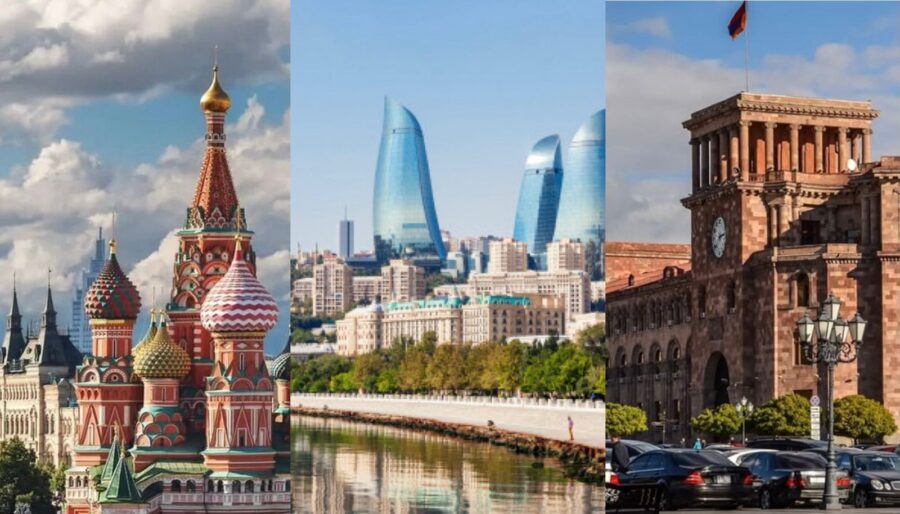
Armenia has again boycotted a meeting of the Collective Security Treaty Organization (CSTO) held in Moscow. CSTO Secretary General Taalatbek Masadilkov said Armenia has effectively left the organization.
The secretary general noted that Armenia does not take part in CSTO meetings, decision-making or military exercises.
How could Armenia’s boycott and its distancing from the organization affect Russia’s positions in the South Caucasus? What changes will this tension in Armenia’s relations with the CSTO bring about in the region, particularly in Baku-Yerevan relations and in the security balance?
Analyst Aqshin Karimov, speaking to Globalinfo.az, said that after Azerbaijan’s military-political victory over Armenia, geopolitical algorithms in the region began to change:
“This also significantly affected Russian-Armenian relations. Although efforts are made to explain and analyse the matter against the backdrop of Armenia’s foreign policy course tilting toward the West, one must look at Azerbaijan’s role in these processes and at the steps through which it is gaining scale.
The policy Azerbaijan pursues, its consistency in foreign policy and its systematic approach influence Armenia’s overall domestic and foreign policy. This is an indicator that Azerbaijan is already acting as a designer in the region.
First, Azerbaijan today is beginning to act as the author of a new political order in Armenia against the backdrop of constitutional change there.
Second, Azerbaijani-Armenian trade relations are affecting economic and trade dynamics in the region. However small the figures may be, when one reads the intentions behind them, it becomes clearly visible which points Baku is targeting in this system of relations.
Third, there is the question of what value or what explanatory points the ruptures in Armenia’s relations with Russia draw attention to against the backdrop of the Azerbaijani issue”.
The expert said that Azerbaijan can both sometimes influence certain relations within Russia itself and determine Armenia’s overall new formula:
“For example, the amendment of the Armenian Constitution, the peace agenda with Azerbaijan, and so on. On the other hand, Azerbaijan, through the course it follows against the backdrop of the US-Iran war, tries to preserve its mechanisms of influence over all these algorithms.

Aqshin Karimov
These are major events, and against the backdrop of the CSTO losing its functionality, Armenia’s departure from that organization shows that the peace dynamic in Baku-Yerevan relations is affecting the balance of power in the region.
Geopolitical positions are not measured by events that can unfold in a single moment. These are strategies formed over years. Russia is expanding its possibilities of intervening in the region by renewing these strategies through its bases. It is still somewhat early to focus on the weakening of Russia’s position in the South Caucasus”.
The analyst believes that, against the backdrop of the policy Azerbaijan pursues, how far Russia’s influence in the region has fallen, or to what extent this matter manifests itself, can be seriously discussed:
“The weakening of the geopolitical ambitions of the Russian factor, or its arriving at an equal result, does not depend on the course Armenia pursues. This is more the result of the policy Azerbaijan implements. On the other hand, Azerbaijan’s relations with the West, China and Russia can already create a certain balancing equilibrium in the region.
Strategies in the post-Soviet space are still being renewed. A process of updating the views of new international and regional players is under way. Against the backdrop of these renewals, Azerbaijan is raising its own strategies to another level. It also modifies them and pursues a policy suited to regional conditions.
It is still too early to speak directly of any player’s position changing or of its leaving the region any time soon”.
Turan Rzayev
Globalinfo.az
Read also