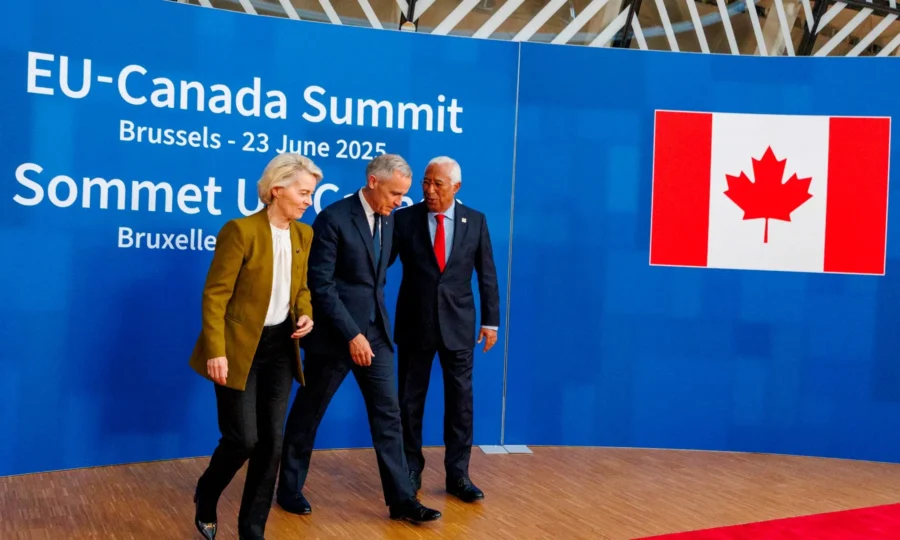
The Canada-European Union (EU) summit held in Montreal has highlighted shifting political relations within the West and the search by the United States’ traditional allies for new strategic partnerships. Disagreements in relations with Washington are pushing Canada and Europe towards closer cooperation in defence, the economy and energy.
This rapprochement is significant not only in terms of expanding bilateral relations, but also for the future of US leadership in the West and the formation of a new balance of power in transatlantic relations.
Could Canada’s move towards a deeper strategic partnership with the European Union be seen as an indication of weakening US influence over its traditional allies? Could stronger integration between Canada and Europe in defence, the economy and technology lead to the emergence within the West of a new centre of power that makes decisions more independently of the United States? How would the formation of alternative strategic partnerships by US allies affect Washington’s global leadership and the future of transatlantic relations?
Political analyst Shahin Jafarli told Globalinfo.az that the rapprochement between Canada and the European Union is undoubtedly a direct result of the policies and global outlook pursued by the administration of US President Donald Trump:
“As is known, after Donald Trump came to power, certain rifts began to emerge not only within the transatlantic alliance, but also within the Anglo-Saxon world. We even witnessed the emergence of contradictions between the brotherly states of Canada and the United States, which had maintained very close allied relations for many decades.
As is known, Trump has imposed trade tariffs on Canada. In addition, by repeatedly stating that the country should become the 51st state of the United States, he has had a considerably negative impact on the nature of bilateral relations. Therefore, the rapprochement between Canada and the European Union has become a necessity. This stems from both sides’ need for one another.
Europe has lost trust in the United States in terms of its defence and economic partnership. At the same time, it has found a new and strong ally in Canada. Naturally, relations between Canada and Europe have always been warm. However, at the current stage, the sides are seeking to develop these relations further and bring them to the level of integration. At the Montreal summit, they also describe this cooperation as a forward-looking alliance.
Both sides have a position on cooperation, first of all in the economic sphere and then on strengthening military cooperation. At a time when Europe’s energy needs are increasing and it is seeking alternative sources to Russia, Canada could become one of the important partners in this area. As is known, Canada is an energy-producing country. It intends to gradually increase liquefied natural gas production.”

Shahin Jafarli

The political analyst said Canada also has opportunities to strengthen its position in Europe’s energy market:
“At the same time, Canada is seeking to fill some of the gaps in Europe’s security and is demonstrating political will in this direction. It is even participating in a programme related to European defence. It has been reported that a decision was made for Canada to contribute 150 billion euros to that programme. In addition, Canada, along with Europe, is one of Ukraine’s main supporters.
All these factors — economic ties and the energy factor — are bringing Canada and Europe closer together.
Canada and the European Union also intend to defend the liberal international order. At a time when the US withdrawal from this alliance has created a serious threat to the liberal order in the world, the sides are also forming an ideological unity.
Undoubtedly, the sides intend to reduce their dependence on the United States. This poses a threat to US leadership within the West. The policies of the current administration are weakening the country’s leadership in Europe. This is in fact a deliberate approach and stems primarily from ideological antagonism.
Today’s Trump administration does not accept the liberal outlook, is increasing pressure on European governments and even openly supports radical right-wing and neo-fascist forces. The Trump administration is pursuing policies aimed at removing the traditional Western elite from the political scene. This forces Europe to develop its own mechanisms of resistance. Canada acts as an important ally in this matter.
The United Kingdom should not be forgotten here either. Canada is one of the countries linked to the British monarchy, and a governor-general serves in the country. Although there is no direct intervention, a certain moral, psychological and political influence continues. From this perspective, the United Kingdom also has a will in deepening the strategic partnership between Canada and the European Union.
Even today, the issue of official London returning to the European Union is being discussed. Overall, the Anglo-Saxon world is moving towards a path with Europe without the United States.”
Turan Rzayev
Globalinfo.az
Read also