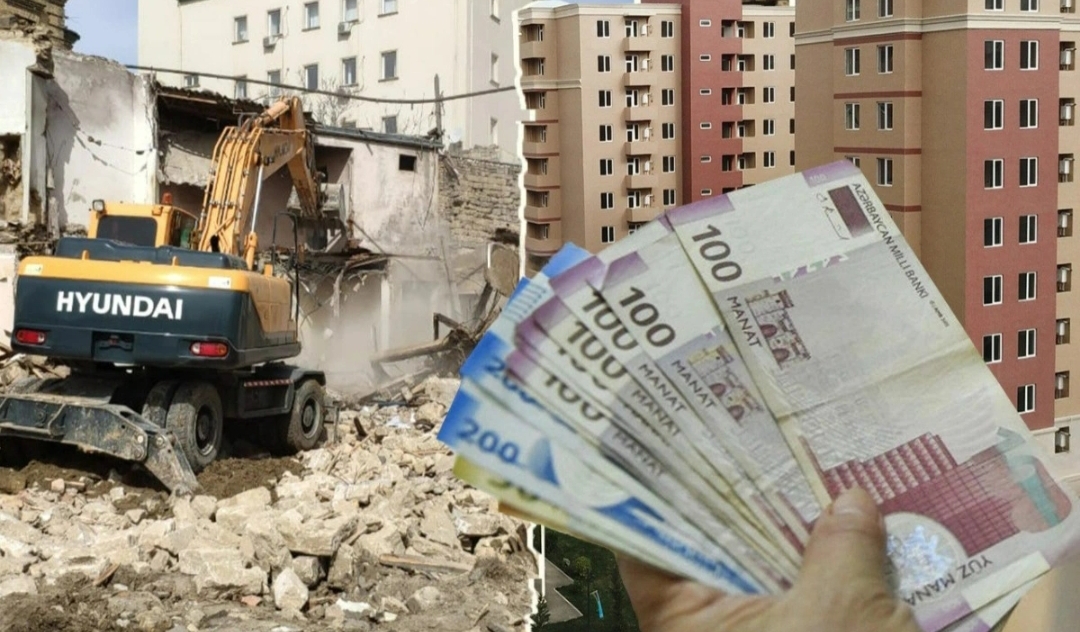
According to Vugar Oruj, chairman of the Azerbaijani Society of Appraisers, alongside Baku and Sumgayit, the demolition and renewal of dilapidated buildings and those whose service life has expired is also planned in Ganja, Nakhchivan and Masalli. It is reported that during demolition, preference will be given to providing residents with alternative apartments rather than monetary compensation.
What does this plan announced by Vugar Oruj promise for residents of the regions? When and by what criteria will the demolition of old and dilapidated buildings be carried out?
Speaking to Globalinfo.az, the head of the Azerbaijani Realtors Association, real estate and construction expert Elnur Azadov, said that about 70 percent of multi-apartment buildings constructed in the Soviet era have exceeded their service life:
“This mainly includes five-storey buildings, as well as many residential buildings built on the basis of various architectural styles and other projects. In particular, the service life of buildings constructed before the mid-1970s has already expired. And this list expands year by year. Among those buildings there are also those in dilapidated and semi-dilapidated condition. Especially in Baku, old two-, three- and four-storey buildings of architectural style predominate. Such buildings are also found in Ganja and Sumgayit. However, the demolition of multi-apartment buildings at state expense is rarely carried out and no large-scale program is envisaged in this direction. Because there is no serious financial planning for this in the state budget. Only in special cases, when a building falls into a seriously dilapidated condition, or within the framework of state-important projects, is demolition work carried out at state expense. For this reason, the demolition process is mainly envisaged to be carried out by the private sector.”
The expert said that since 2016, district executive authorities had been issuing orders for the demolition of buildings located in their areas whose service life had expired, that were dilapidated and semi-dilapidated, as well as those that spoil the modern appearance of the city and do not meet standards:
“This process lasted only two years, and during that period hundreds of residential complexes were built in the country. However, from July 2018, with the transfer of the relevant powers to the Architecture Committee, the process was halted. And in 2019, Cabinet of Ministers decision No. 86 was abolished altogether. Another example is decision No. 83 adopted in April 2017. That decision envisaged the demolition of the First microdistrict. Nevertheless, almost nine and a half years have passed, and demolition work in the area has still not been carried out. The reason is that such projects are not economically efficient enough. That is, even if there is a Cabinet of Ministers decision and an opinion from the Ministry of Emergency Situations, the economic justification of demolition projects is also important.


Elnur Azadov
It is reported that currently there are about 20,000 multi-apartment buildings in Baku and the Absheron area whose service life has expired. However, only a very small part of them can be included in the demolition plan. When and on what scale this will be carried out is unclear. It should be taken into account that the number of relevant orders issued by the Architecture and Urban Planning Committee since 2019 is quite limited, and certain restrictions are applied in this area.”
E. Azadov noted that compared with 2016, the number of construction companies and market participants is expected to decrease by at least 70-80 percent:
“This means that in the near future construction permits will be issued to a limited number of companies. In addition, new construction and urban planning norms, and the legislation and rules applied in the direction of saving energy resources and reducing carbon emissions, also affect the activities of construction companies. In such conditions, the number of companies that will continue operating in this sector may decrease further.
It is impossible to say now when the demolition process will expand. This depends on when the Architecture Committee begins to issue relevant orders to construction companies on a mass scale, and on the removal of existing restrictions. This is a problem whose solution may take many years. If a state policy is formed in this direction in the future, if the restrictions applied to construction companies are removed and the economic importance of increasing their number is justified, it will be possible to start mass demolition work.”
Laman Imran
Globalinfo.az
Read also