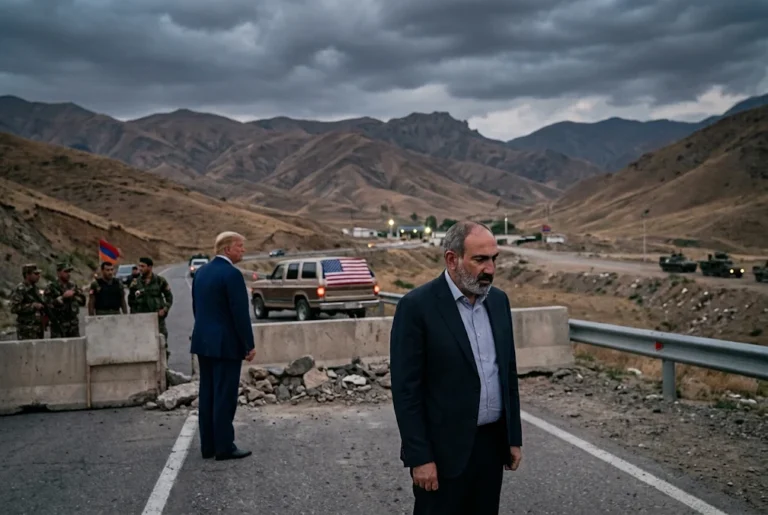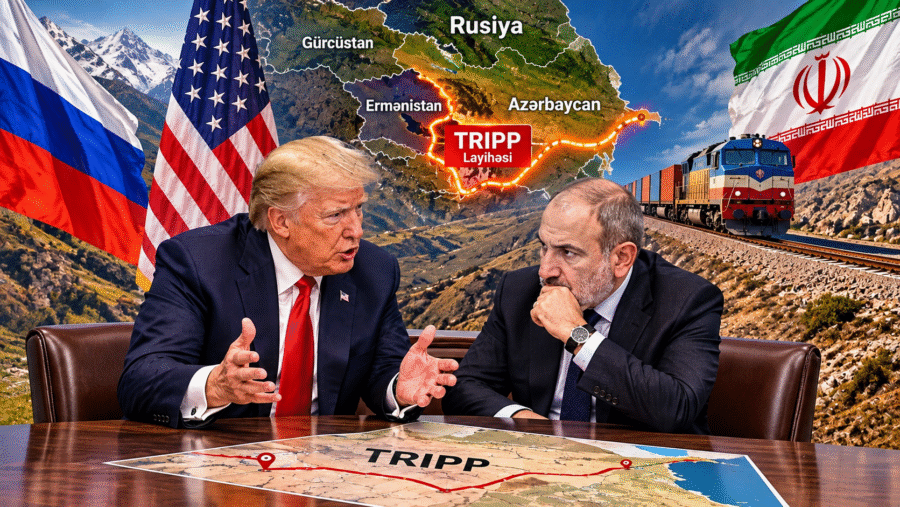
US President Donald Trump and Armenian Prime Minister Nikol Pashinyan announced yesterday that implementation of the TRIPP project has begun. Trump thanked Pashinyan and Azerbaijani President Ilham Aliyev for carrying out the project.
The head of state also thanked the US leader for the kind words addressed to him.
So, has the threat from Russia and Iran to the implementation of the TRIPP project been completely eliminated? When will the project be completed and the road opened to traffic?
Speaking to Globalinfo.az, political analyst Tamilla Gulami said that the event capable of producing a serious change in the geopolitical landscape of the South Caucasus after Azerbaijan’s victory over Armenia is the TRIPP project’s move to the practical implementation phase on 23 November 2026:
“The political will demonstrated in this process by US President Donald Trump, Armenian Prime Minister Nikol Pashinyan and Azerbaijani President Ilham Aliyev shows that the project has already moved from diplomatic discussions to a real economic and infrastructure stage. Does this event mean that Russia’s and Iran’s ability to obstruct the project has been completely eliminated? I still think it is too early to reach such a conclusion. True, despite all this, Russia’s and Iran’s capacity for political pressure against the project may be considerably limited compared with the previous period. Because TRIPP is no longer merely a regional transport initiative discussed between Azerbaijan and Armenia, but an international project in which the United States has direct political and economic interests. In particular, the creation of the TRIPP Development Company and the envisaged model in which the United States holds a 74 percent stake and Armenia 26 percent ensures Washington’s long-term participation in the process. Therefore we can say that this is an important political guarantee for the project’s security.
As for the Russian question, the weakening of Moscow’s traditional levers of influence in the South Caucasus may accelerate further with the realisation of this project. For a long time Russia has used its ability to influence the region’s transport and communication lines as one of its geopolitical levers. The entry of the United States into the process also limits these mechanisms of influence. But it would be naive to think that Russia’s ability to influence the region in the economic, political and security spheres has completely disappeared.”

Tamilla Gulami
The political analyst noted that the situation is also complicated for Iran here:

“Thus, both after the 44-day war and now, Tehran considers the weakening of its border with Armenia and of its transit position in the region undesirable from the standpoint of its geopolitical interests. In particular, the creation of an unimpeded transport link between Azerbaijan and Nakhchivan may have certain effects on Iran’s regional transit importance. Nevertheless, the implementation of the project within the framework of Armenia’s sovereignty and territorial integrity makes it difficult for Iran to justify its objections legally. So the Iranian threat has not been removed; it is simply that the possibilities for open interference in the project have been placed in a more risky and complicated situation.
So when can the road be opened to traffic?
Although no confirmed specific final schedule for the project’s full commissioning has been announced at present, preparatory and pre-construction work began in Armenia on 23 November, particularly in the direction of the Mehri area of Syunik province. The envisaged link of approximately 42 kilometres covers road and rail infrastructure as well as energy and other communication lines. According to information also provided by the Anadolu Agency, the next stage must settle technical design, financing, construction and border-crossing procedures.
I believe that if all political and technical issues are agreed, the opening of the project’s main transport section in 2028–2030 could be a realistic target. In particular, much of the work could be carried out during Trump’s time in power.
The main point is that TRIPP is not simply a road that will connect Azerbaijan with Nakhchivan. This project means the strengthening of the Middle Corridor, the expansion of access to Europe across the Caspian Sea and the formation of a new geoeconomic reality in the South Caucasus. The participation of the United States in the project also increases its strategic importance. For Azerbaijan, this is a historic opportunity both in terms of providing a direct overland link with Nakhchivan and in terms of expanding regional transit opportunities.
But although Russia’s and Iran’s ability to stop the project is weaker today, it is difficult to say that the threats have been completely eliminated. We face a serious period of testing. The real test is not the start of construction, but the transformation of the political agreement among all three countries into a sustainable and workable transport system.”
Turan Rzayev
Globalinfo.az
Read also