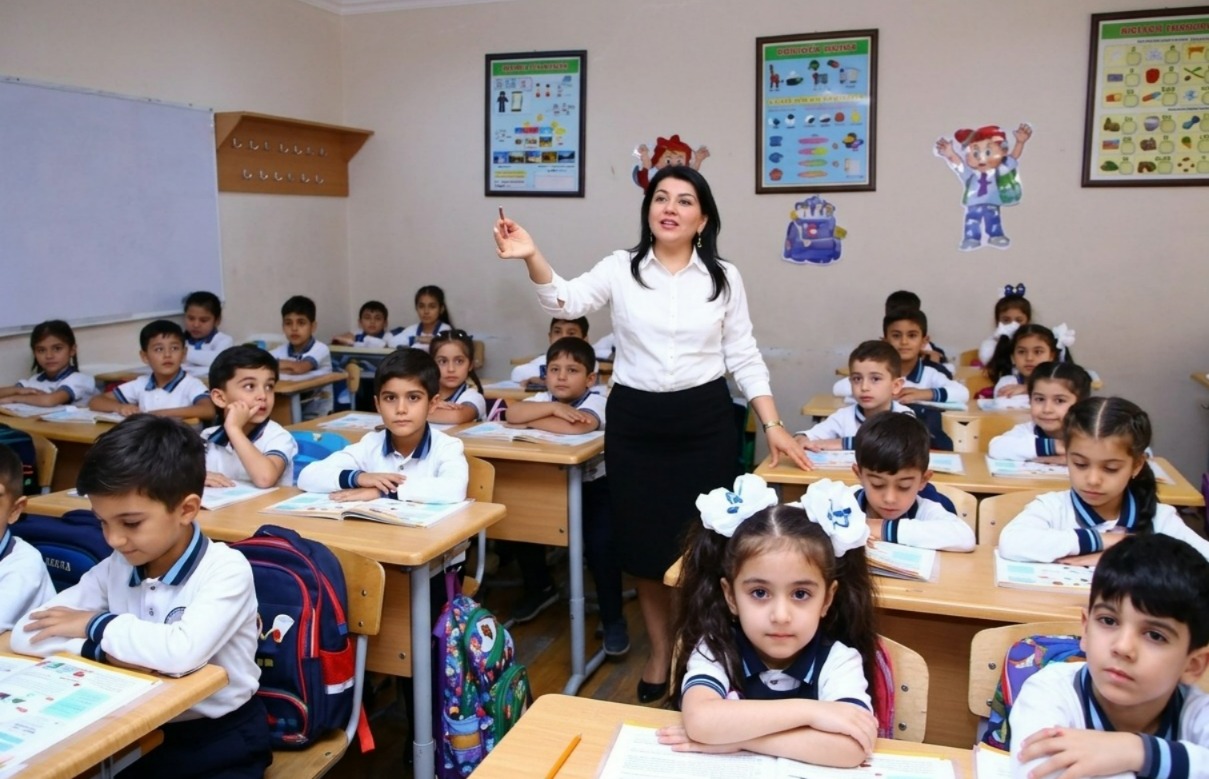
The issue of showing yellow, red and green cards to students in Azerbaijani schools has come back onto the agenda. Views on the application of this rule are not unanimous: while it has been introduced in some schools, in others the process has not begun.
So what is the current situation? Overall, how effective is this rule? It is claimed that some teachers erase red cards in exchange for money. How can this be controlled?
Honoured teacher Sona Aliyeva, speaking to Globalinfo.az, said the reason for the confusion over the card system in schools is simple:
“There is a rule, but not everyone knows how it works. According to the official position, the student behaviour rules have not been abolished. After a two-year pilot phase, they are to be applied in all state schools. In reality, however, in one school the cards are issued regularly, while in another this system remains almost on paper.”
S. Aliyeva said that what is decisive here is not the colour of the card, but how it is used:

“The strongest side of the system is the green card. Noting and rewarding a child’s good behaviour is one of the most effective methods tested around the world. Positive behaviour support programmes applied in many countries show the same result: rather than punishing a child, teaching them the right behaviour and valuing it is more beneficial.
Punishment cards, however, carry their own risks. If a red card is given in front of the whole class in a way that humiliates the child, then instead of correcting their behaviour the child either withdraws into themselves or becomes more aggressive. International studies also confirm that strict discipline models based only on punishment do not make schools safer. That is why the card should be the starting point of upbringing, not its end point. Behind every red card there must be a conversation with a psychologist, a meeting with the parent and an attempt to understand why the child behaved in exactly that way. Otherwise the card simply turns into a piece of paper pinned to a personal file.”

According to Sona Aliyeva, the most troubling issue is the claims that cards are erased in exchange for money:
“These claims have not been proven, but the emergence of suspicions is itself a signal. When the system operates on paper and by the decision of a single person, the risk of abuse always remains. If the same teacher both issues and can erase the card, it becomes difficult to speak of transparency. In my view, preventing this is not so complicated. First of all, the cards should be moved to an electronic system. Who issued each card, when and for what reason must remain in a digital trace. The erasure of a card should be possible not at the wish of one teacher, but by a joint, written and justified decision of the deputy principal, the psychologist and the class teacher. The parent must receive automatic notification about every card, so that later no card “disappears”. The ministry’s hotlines should be publicised more widely. A parent facing such an incident must know exactly whom to contact. In a word, the card system is not a bad idea, but its success depends on two things: transparency and the pedagogical approach. The purpose of the card must be not to frighten the child, but to show them the right way.”
Zaira Akifgizi
Globalinfo.az
Read also