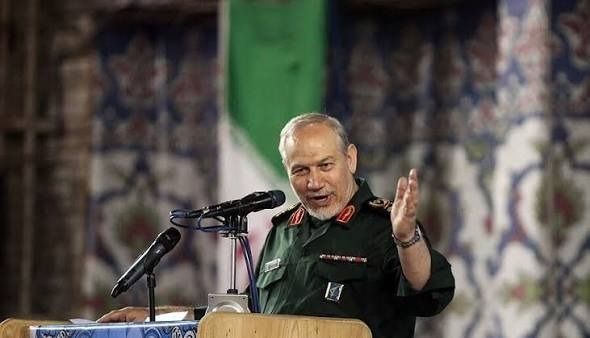
As discussions intensify over possible US military intervention in Iran, increased military-political contacts along the Tehran-Beijing axis have drawn attention. The Iranian delegation’s visit to China at Beijing’s invitation, led by Yahya Rahim Safavi, military adviser to Supreme Religious Leader Mojtaba Khamenei, does not appear to be a routine diplomatic engagement.
In particular, planned meetings with China’s chief of general staff, defence minister and members of the Central Committee during the visit show that the military-strategic agenda has gained prominence in Beijing-Tehran relations. All this raises questions about whether a new geopolitical landscape is taking shape around possible US military scenarios.
Speaking to Globalinfo.az, political commentator Javanshir Abbasli said it was no coincidence that the killing of senior state officials and generals in previous US operations against Iran had again been brought to the forefront of the global agenda:
“However, I believe that under the current circumstances, it does not appear very realistic for Washington to carry out another large-scale operation of the same nature against Iran.
Iran is no longer the Iran it once was. In particular, it can be assumed that our neighbouring country’s security system has to some extent addressed the gaps that emerged after it suffered serious blows in two nighttime operations. Of course, this does not mean that Iran has eliminated all its weaknesses. But the United States now faces different conditions and a more complex geopolitical landscape if it is to repeat the previous operations.
The conduct displayed by US President Donald Trump during his meeting in Shenzhen with Chinese leader Xi Jinping and Russian President Vladimir Putin also reinforces these assumptions. It does not appear very realistic for a new operation against Iran to begin after the historic meeting of the world’s three major powers. It is true that statements made after the meeting gave the impression that the issues of Ukraine and Iran were not discussed extensively. Apart from statements by Putin that there would be a response to attacks on the Crimean Bridge, we did not see any serious announcements.”


Javanshir Abbasli
The political commentator said there was a fairly high likelihood that the issues of Ukraine and Iran were discussed behind closed doors:
“At such important meetings, not every issue is expected to be disclosed to the public. In particular, the fact that global powers such as the United States, China and Russia do not openly state their positions on regional conflicts does not mean that diplomatic talks are not taking place. The Iranian delegation’s visit to China is also noteworthy in this respect. These contacts to some extent reduce the likelihood that America will launch large-scale operations against Iran, repeat the attacks carried out on February 28, and once again target senior state officials and generals. This is because Iran’s intensification of diplomatic ties with China gives grounds to believe, at the very least, that Beijing is not interested in a further escalation of the current situation.
In my view, developments around Iran may continue in a largely frozen state at this stage. But another point must also be considered. Iran’s close relations with Russia and China are well known. For Tehran, which maintains strategic ties with these two states, their position is of particular importance. At the same time, there is no doubt that the United States will make serious calculations before taking steps that could create new tensions in its relations with China and Russia.
Taking all this into account, I do not consider the likelihood of a third wave of operations against Iran beginning after the trilateral meeting to be high. At least under the current geopolitical conditions, such a move would have serious political and strategic consequences for Washington.”
Turan Rzayev
Globalinfo.az
Read also