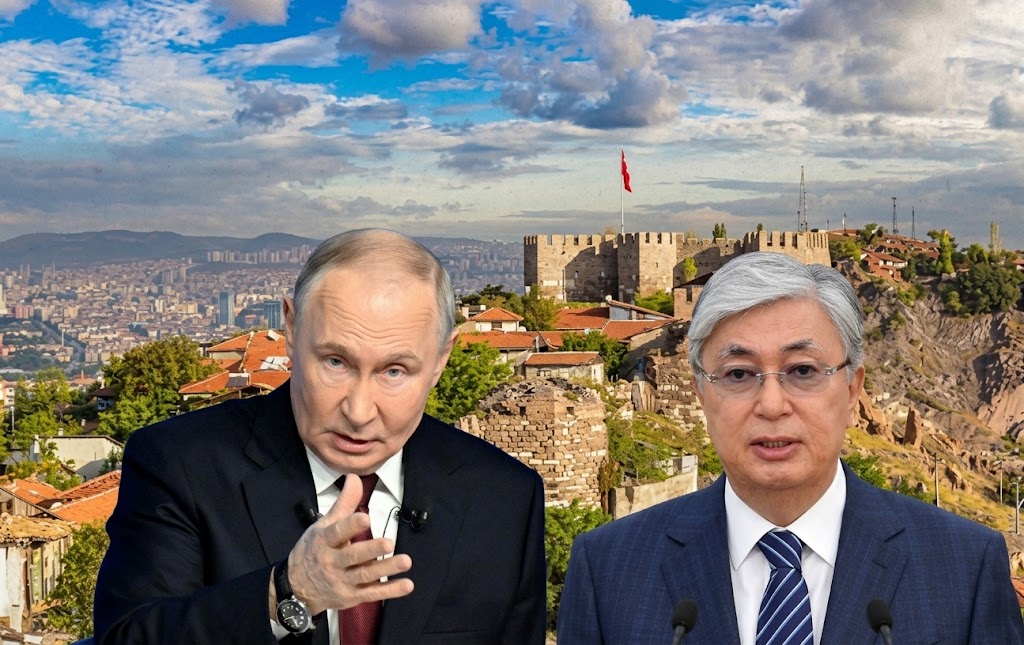
A proposal to expand the Organization of Turkic States (OTS) has sparked political debate. Ankara gave a negative response to Kazakh President Kassym-Jomart Tokayev’s proposal to admit Russia to the organisation. Kursad Zorlu, deputy chairman of Turkey’s ruling Justice and Development Party for relations with Turkic states, said Russia’s membership in the organisation was impossible.
How will Tokayev react to this response? Could Russia split the OTS?
Political commentator Faiq Alekberli told Globalinfo.az that Tokayev’s proposal was thought-provoking:
“It would be wrong to assess this initiative unequivocally as either positive or negative. Perhaps, as Tokayev himself noted, the proposal was put forward with the interests and concerns of Turkic peoples living in Russia in mind. At the same time, it is a reality that numerous Turkic peoples live in the Russian Federation and that a large part of our historical lands is now within Russia’s territory. From this perspective, the proposal can be understood to some extent. However, when we look at the history of the Federation, we see that the process of transforming the small Moscow Tsardom into a large empire did not occur solely at the expense of Slavic and European lands. A large part of Russia’s territory, including regions such as Siberia, the Urals and the Caucasus, is connected with the ancient lands of Turkic peoples. Another aspect of the matter is that the state which evolved from the Moscow Tsardom into Tsarist Russia, Soviet Russia and finally the Russian Federation has inflicted serious damage on the languages, cultures, national and spiritual values, and traditions of Turkic peoples through its policy of Russification. This is a historical reality. The Russian Federation has not renounced succession from Tsarist Russia and Soviet Russia. In that case, its admission as a member of the Organization of Turkic States is, of course, unacceptable.”

Faiq Alekberli

The political commentator said Kursad Zorlu’s statement on the matter was logical:
“Some Turkic peoples were once involved in TURKSOY and other institutions, but were later excluded from the process due to Russia’s intervention. Tokayev himself knows these issues better than we do and is sufficiently aware of the historical realities I mentioned. Apparently, there are certain aspects behind the issue that we do not know. Perhaps for these reasons, Tokayev proposed inviting Russia to the organisation at least as an observer. I believe Tokayev’s position on this issue will also remain within the framework of mutual understanding. I hope that OTS leaders and the relevant bodies will comprehensively consider the issue, make a decision based on a common understanding and continue their activities.
Russia’s representation in the OTS could cause a split within the organisation and also create conditions for it to increase its influence on certain issues. It should be taken into account that the Federation has serious leverage over many states, including independent Turkic states. Therefore, I think it would be more appropriate to leave this issue open for now. It would be more correct for Russia not to be represented in the OTS even as an observer.”
It should be noted that the five full members of the Organization of Turkic States (OTS) are Azerbaijan, Turkey, Kazakhstan, Kyrgyzstan and Uzbekistan. Its observer states are Hungary, Turkmenistan and the Turkish Republic of Northern Cyprus.
Laman Imran
Globalinfo.az